
Let’s be real about something most Miami Beach travel guides won’t say out loud: South Beach has a reputation that makes family travel sound difficult. The nightclub energy, the $65 margaritas on Ocean Drive, the Instagram influencers, the general sense that this place was designed for people without bedtimes or babysitters.
Here’s what those guides miss: Miami Beach is genuinely one of the most family-accessible beach destinations in Florida, if you know which parts are for you and which to skip. The beach itself is extraordinary — wide, warm, with calm turquoise Atlantic water that’s significantly gentler than the Outer Banks or Cape Cod. Lummus Park runs right behind the sand with playgrounds and shade. The Art Deco architecture is the most unique urban backdrop of any beach in the country. And the city has quietly built a solid family infrastructure that operates completely parallel to the nightlife scene.
The trick is understanding Miami Beach as two places that happen to share the same zip code: the South Beach that’s in the travel glossies, and the South Beach that works beautifully for families. This guide is about the second one.
Key Takeaways
- South Beach’s ocean water is warm (82–86°F in summer), clear, and calmer than most Atlantic beaches — genuinely good for young swimmers with active supervision
- Ocean Drive is worth seeing once but don’t eat there — prices are tourist-inflated and food quality rarely matches. Walk it for the architecture, then eat literally anywhere else
- The Miami Beach Boardwalk runs 2.5 miles from South Pointe north to 46th Street — the best free morning activity on the island, especially before crowds arrive
- Lummus Park, running parallel to the beach from 5th to 14th Street, has playgrounds, shade trees, and restroom access — the family base camp of South Beach
- Late October through November is the sweet spot for families — water still warm (80°F+), summer crowds gone, accommodation prices drop significantly, and the weather is genuinely ideal
The Beach Itself — What to Actually Expect
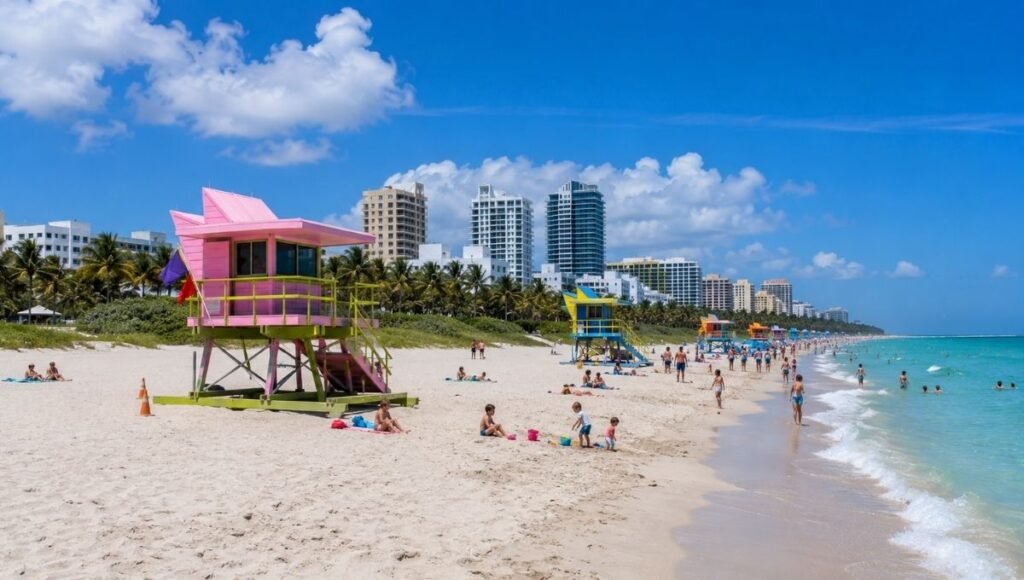
South Beach’s sand is the kind that photographs well and delivers in person: wide, white, and clean. The water is warm, clear enough to see your feet, and calmer than you might expect from an Atlantic-facing beach. The waves are real but manageable — not the dramatic surf of the Outer Banks or Cape Cod, more like a gentle rhythm that older children love for wave-jumping and younger ones can handle in the shallower zones.
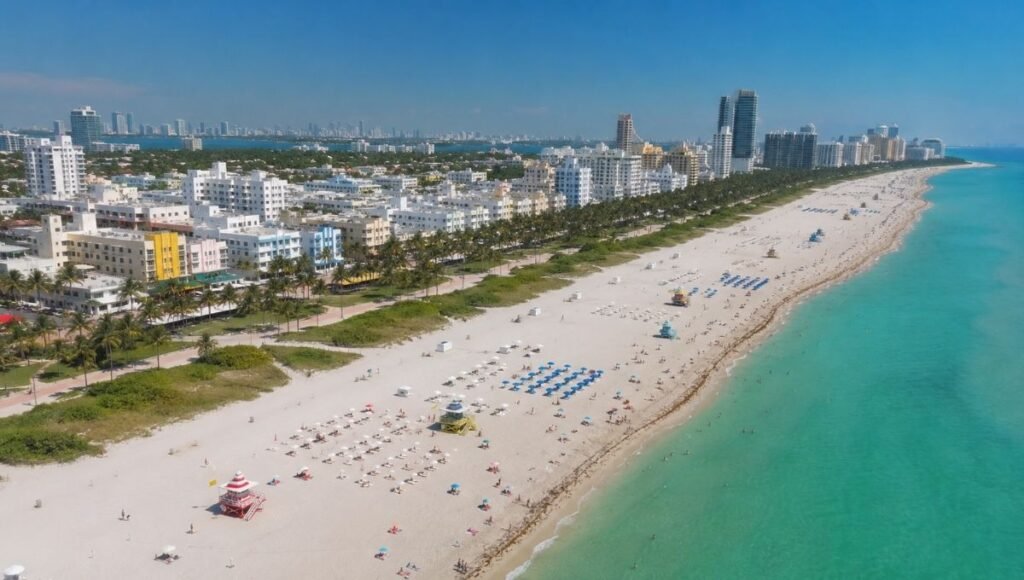
The beach runs the full length of Miami Beach — 7 miles from South Pointe in the south to the northern tip near 87th Street. Families gravitate toward the Lummus Park section (5th to 14th Streets) because of the playground, shade structures, restroom access, and lifeguard stations that operate during daylight hours. This stretch is also where the iconic colored lifeguard stands are — the pastel towers that have become Miami Beach’s most recognizable visual symbol.
The honest crowd reality: July and August on South Beach are genuinely crowded. The beach is wide enough that it never feels claustrophobic, but parking is a real challenge and the water is packed on summer weekends. Arriving by 8:30 AM on summer weekends is the only reliable strategy if you’re driving.
Where families actually set up: Lummus Park between 8th and 12th Streets hits the sweet spot — close enough to the Ocean Drive architecture to feel the energy, far enough from the most concentrated tourist chaos to breathe. The park’s playground is a genuine asset for families with children under 8 who need breaks from the sand.
Things to Do in Miami Beach for Families
Ocean Drive — Walk It, Don’t Eat It
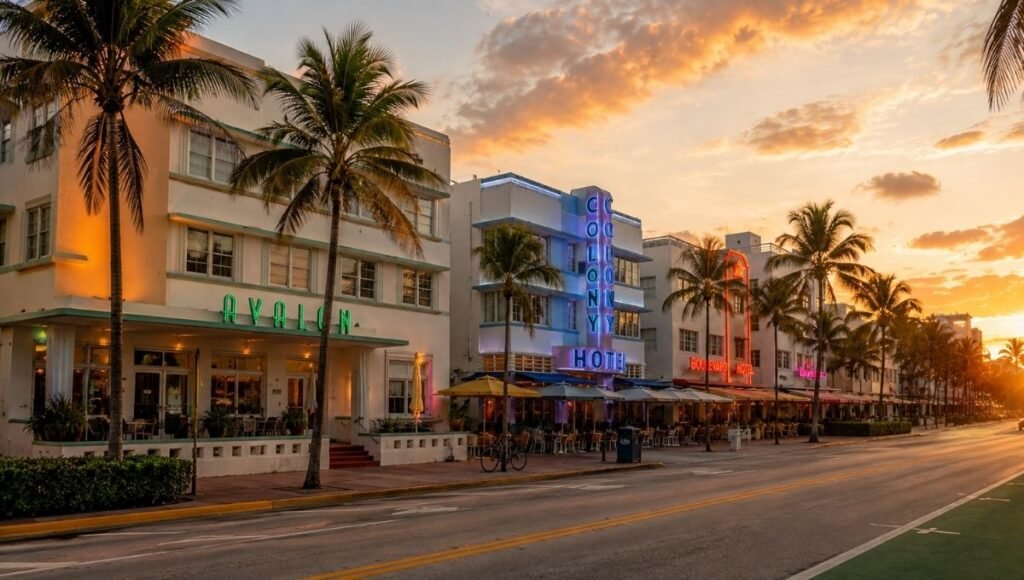
Ocean Drive is 1.5 miles of Art Deco architecture, neon signs, sidewalk cafés, people-watching, and genuine visual spectacle. The buildings were designed in the 1930s and 1940s and are now the largest collection of Art Deco architecture in the world. Walking the strip is one of the more genuinely interesting urban experiences attached to any beach in the country.
The catch: The sidewalk café scene on Ocean Drive is aggressively tourist-priced. Drinks are expensive, food quality is inconsistent, and the hawkers trying to pull you into restaurants can be exhausting with kids in tow. Walk the Drive for the visual experience. Eat somewhere else.
What to actually do on Ocean Drive:
- Walk it at sunrise — the golden light on the pastel buildings is spectacular and the street is quiet
- Look for the Colony Hotel (1935, Henry Hohauser), the Avalon, and the Cardozo — the most photographed buildings on the strip
- The Versace Mansion (now Villa Casa Casuarina) at 1116 Ocean Drive is worth a photo stop — it’s now a hotel and restaurant, and the gates are occasionally open for guests
Editor’s take: Ocean Drive gets unfair criticism. Yes, it’s touristy. Yes, it’s overpriced for dining. But the architecture is genuinely extraordinary and you can’t really understand Miami Beach without walking it at least once. Just eat before you go.
The Miami Beach Boardwalk — Best Free Morning Activity
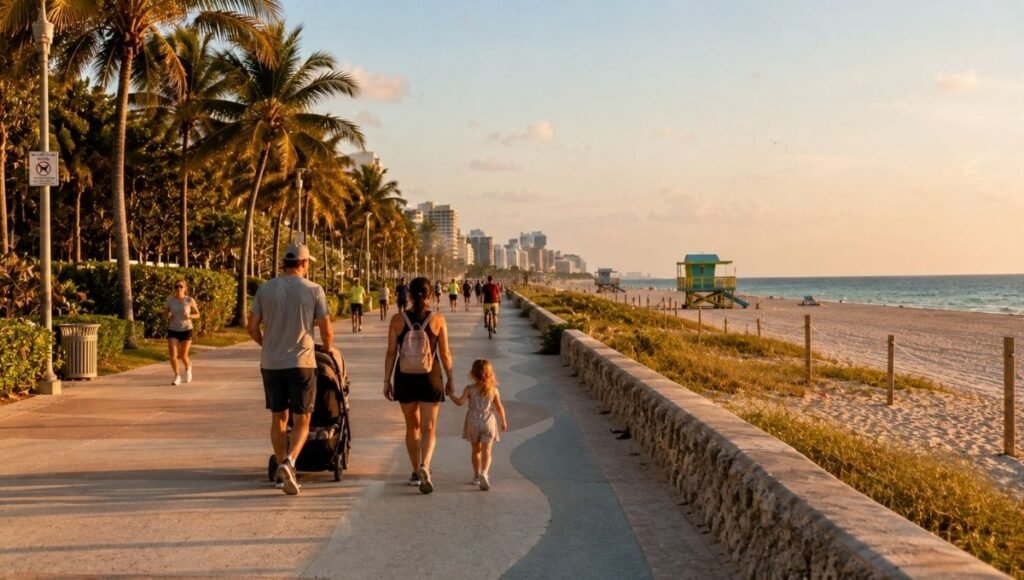
The Miami Beach Boardwalk runs 2.5 miles along the back of the beach from South Pointe Park north to 46th Street. It’s paved, flat, and wide enough for strollers, and in the morning — before 9 AM — it’s one of the more pleasant walking experiences in Florida.
Joggers, cyclists, dog walkers, elderly locals doing their morning constitutional, and families with strollers all share the path in the early hours. The ocean is right there, the light is beautiful, and the energy is completely different from the midday South Beach scene. This is the Miami Beach that residents actually use.
With young children: The boardwalk stroller-friendly surface makes it practical for families with infants and toddlers who can’t manage long beach walks on sand. The Starbucks at 15th Street is the unofficial start point — coffee, then walk north.
South Pointe Park — The Hidden Family Gem
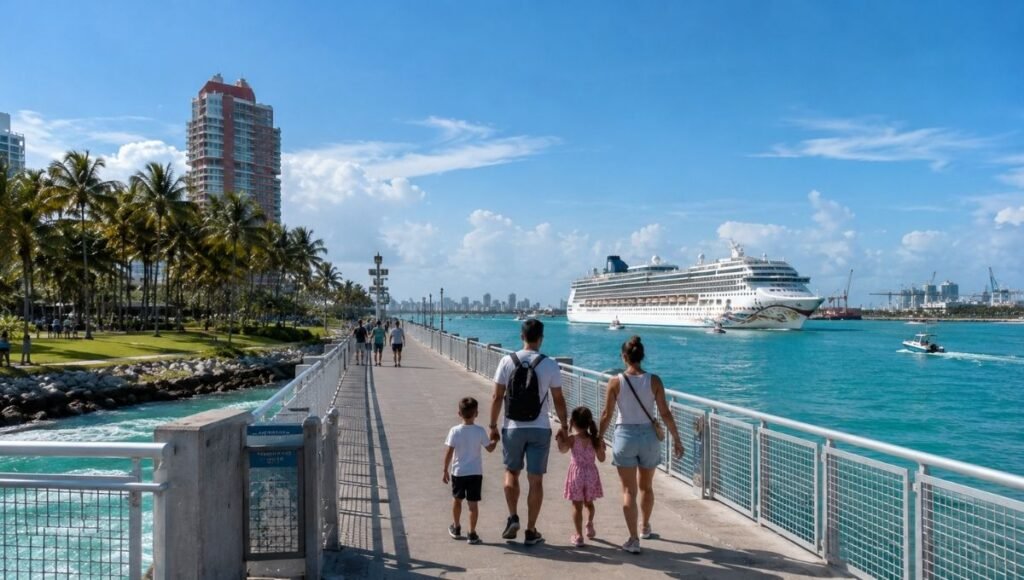
At the southern tip of South Beach, South Pointe Park is a 17-acre waterfront park that most tourists walk past on their way to the Pier. The park has genuine play structures for children, wide green spaces for running, shade trees, and views of cruise ships entering Government Cut — the channel that separates Miami Beach from the mainland.
The Pier at South Pointe extends into the water with views back toward the South Beach skyline and across the channel. Fishing is permitted on the pier. The park has clean restrooms and water fountains — practical details that matter a lot when you have young children.
Our honest take: South Pointe Park is one of the most underutilized family assets in Miami Beach. Most visitors are at the Ocean Drive end of the beach. The park is quiet, maintained, and genuinely beautiful.
Flamingo Park — For When the Beach Is Too Much
Flamingo Park is a large municipal park in the middle of Miami Beach (west side, away from the ocean) with a water playground, swimming pools, tennis courts, and walking trails. For families who need a break from the Atlantic — or whose children are too young for ocean swimming — Flamingo Park offers water play in a controlled, supervised environment.
The water playground specifically is well-designed for young children — interactive jets, sprinklers, and shallow splash areas that work for the 2–8 age range without the ocean variable.
When to go: Any time the beach seems too crowded or the surf is running too high. Also genuinely useful for the late afternoon when the beach heat peaks — the park has shade that the beach doesn’t.
The Art Deco Historic District — Walking Tour with Kids
The Art Deco Historic District covers roughly 1 square mile around Ocean Drive and Collins Avenue and is the architectural heart of Miami Beach. The Miami Design Preservation League runs walking tours of the district — 90 minutes, knowledgeable guides, genuinely interesting for adults and older children.
For families with younger children who can’t sustain 90 minutes of architectural commentary, self-guided walking along Ocean Drive and Collins Avenue covers the most important buildings. Look for the flamingo motifs, the porthole windows, the eyebrow overhangs that shade the windows from the Florida sun — specific details that give children something to look for.
Practical: The tour meets at the Welcome Center at 10th Street and Ocean Drive. Check current schedule and pricing with MDPL before visiting — operating hours vary seasonally.
Bike Rental and the Collins Avenue Corridor
Miami Beach has a bike rental infrastructure along Collins Avenue — SoBe Bikes, Citi Bike stations, and multiple rental outfitters. The flat terrain and the bike path along the Boardwalk make cycling genuinely practical for families.
Cycling south on Collins Avenue and then onto Ocean Drive gives families the full Art Deco experience at their own pace, without fighting pedestrian crowds on foot. Returning north along the Boardwalk path gives you the ocean view. The loop is about 5 miles total — manageable for families with children 7+ who can ride.
For families with young children: Child seats, tagalong attachments, and some carriers are available from rental outfitters. Confirm before booking.
Snorkeling at South Pointe and Government Cut
The water clarity at South Pointe — where Government Cut meets the Atlantic — is good enough for snorkeling on calm days, and the underwater environment is more interesting than the main beach area. Small reef fish, occasional sea turtles, and the distinctive South Florida inshore species are all visible.
For families who did snorkeling on Florida’s Gulf Coast (Siesta Key, Panama City Beach), the experience here is different — more open ocean influence, slightly more current to manage, but worthwhile on calm mornings.
Equipment: Rent gear at any of the South Beach dive shops on Collins Avenue rather than buying disposable gear at tourist shops.
Miami Children’s Museum — The Indoor Option
The Miami Children’s Museum is on Watson Island, about 4 miles from South Beach across the MacArthur Causeway. It’s a hands-on interactive museum designed for children under 10 — exhibits include a working television studio, a construction zone, a music room, and various themed play spaces.
This is the right call for rainy days, extremely hot midday hours, or when you have a child in the 2–6 range who needs contained supervised activity. Budget 2–3 hours.
Practical: Drive or Uber — it’s not walkable from South Beach. Parking available on site. Check current admission prices at miamichildrensmuseum.org before visiting.
Miami Beach vs Other Florida Beach Destinations
Miami Beach is genuinely different from Florida’s Gulf Coast destinations, and understanding that difference saves you from bringing wrong expectations.
Miami Beach vs Clearwater/Siesta Key: Gulf Coast beaches have calmer water, whiter sand, and a quieter atmosphere. Miami Beach has more urban energy, a world-class cultural scene alongside the beach, warmer winter temperatures, and the Art Deco backdrop that’s unique in the world. Miami Beach is a city-beach experience; Gulf Coast beaches are resort-beach experiences.
Miami Beach vs Destin/Panama City Beach: The Gulf has more emerald-colored water and quieter beach towns. Miami Beach has more to do beyond the beach — museums, architecture, dining diversity, events. If your family wants pure beach with no distractions, the Gulf Coast wins. If your family wants beach plus genuine urban culture, Miami Beach wins.
Our honest take: Miami Beach works best for families with older children (8+) who can engage with the city’s culture, food scene, and visual variety. For families with very young children seeking a pure beach experience, Gulf Coast destinations are lower-stress. Miami Beach is more stimulating, which is a good thing for some families and exhausting for others.
When to Visit Miami Beach with Kids
October and November: The sweet spot. Water temperature is still 80°F+ (warmest ocean water in the continental US at this time of year), summer crowds have cleared, accommodation prices drop 20–35%, and the weather is genuinely ideal — sunny, low humidity, occasional afternoon showers that clear quickly. Late October specifically is one of the best times to visit Miami Beach for families.
December through February: Still warm enough to swim on sunny days (water runs 72–76°F), beach less crowded than any other season, winter escapes from northern states make it busy enough to feel alive without being overwhelming. The best winter beach in the continental US, consistently.
March and April: Spring Break (mid-March) brings large young crowds to South Beach — the week-long peak is genuinely not ideal for families. April recovers and is excellent.
June through August: Peak summer. Water warmest (84–86°F). Beach crowded. Accommodation at highest prices. Daily afternoon thunderstorms are a genuine pattern — plan beach mornings and indoor afternoons in summer. The July 4th weekend and peak August weeks are the most crowded of the year.
Practical Miami Beach — Parking, Getting Around, Safety
Parking
Parking is the most universally complained-about aspect of Miami Beach and the complaint is valid. Street parking in the South Beach area is metered and fills quickly. The city garages (7th Street, 12th Street, 17th Street) charge $2–$4/hour and are the most reliable option.
The practical approach: If you’re staying in South Beach, choose accommodation with included parking. If you’re day-tripping, arrive before 9 AM for street spots or budget for garage parking. Uber/Lyft from the mainland is increasingly the right call for families who want to avoid the parking logistics entirely.
Getting Around
The South Beach Local is a free circulator bus running the length of South Beach — useful for families with strollers who need to cover distance without walking in heat.
Citi Bike stations are throughout the island for cycling.
Uber and Lyft operate reliably throughout Miami Beach and are often the most practical option for families moving between South Beach and other Miami attractions.
Beach Safety
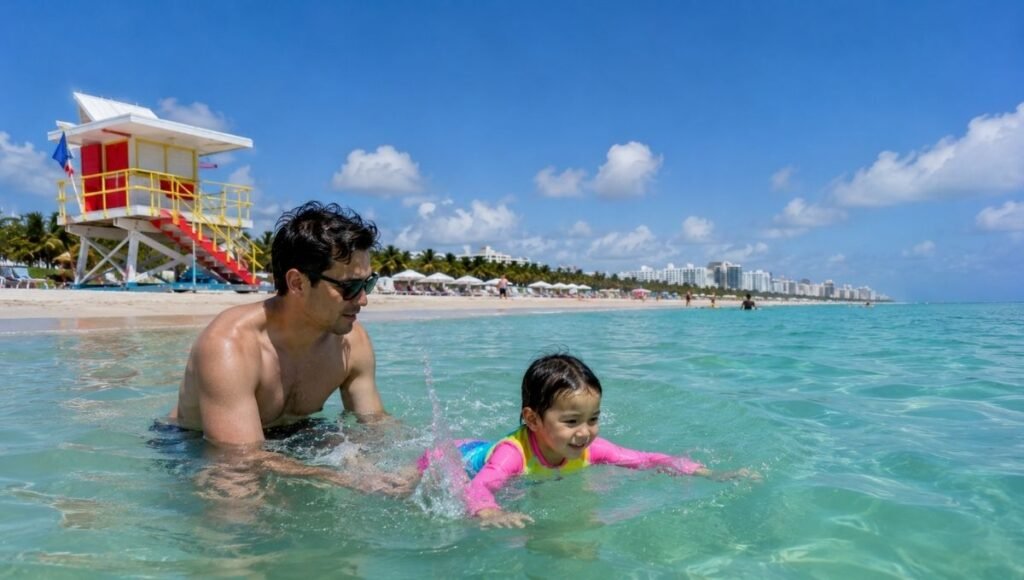
South Beach’s lifeguarded beach sections run from 1st to 24th Street, with towers staffed during daylight hours in summer. Swim within the flagged zones with children.
UV intensity: Miami Beach summer UV index regularly hits 11–12 (Extreme) — higher than most US beach destinations due to latitude and tropical sun angle. Apply SPF 50+ mineral sunscreen 30 minutes before beach exposure. Reapply every 90 minutes and immediately after swimming. UPF rash guards for children are genuinely worthwhile for extended beach days.
Ocean current: The water near Government Cut (South Pointe area) has stronger currents than the main beach sections due to tidal flow through the channel. Swim at the main beach sections (5th to 14th Street) with young children rather than at the tip of South Beach.
Jellyfish: Portuguese Man o’ War occasionally drift inshore during certain wind conditions. If the beach is flagged with purple (dangerous marine life warning), check conditions before entering the water. Man o’ War stings are significantly more painful than standard jellyfish stings — seek medical attention for widespread contact or any allergic reaction.
If You Only Have One Day in Miami Beach with Kids
7:30 AM: Walk the Boardwalk from 15th Street south. Morning light on the Art Deco buildings from the Boardwalk side is genuinely beautiful. Stop at Starbucks or a local café for breakfast.
9 AM: Beach at Lummus Park (8th–12th Street). Kids in the water, adults on towels. Two hours of this before the heat peaks.
11 AM: Walk Ocean Drive north to south for the architecture. Do not eat here.
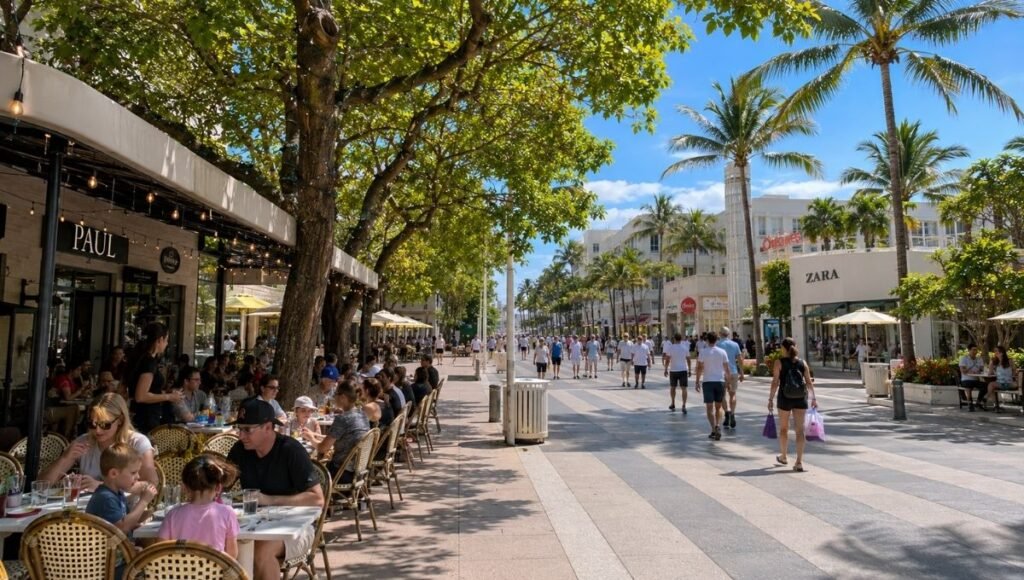
12:30 PM: Lunch on Lincoln Road (pedestrian mall, 16th Street) — better food, better prices, shade.
2 PM: South Pointe Park. Pier walk. Cruise ship watching. Playground for younger kids.
4 PM: Return to the beach for late afternoon — lighter crowds, better light for photos, water still warm.
Evening: Collins Avenue dinner, then ice cream and a final walk along the Boardwalk as the lights come up.
Frequently Asked Questions
Is Miami Beach good for families? Yes — specifically South Beach works well for families with children 5+. The beach itself is beautiful and manageable, Lummus Park has playground facilities, and the Art Deco district provides genuine cultural context. Very young toddlers are better served by Gulf Coast destinations with calmer water, but older children engage well with Miami Beach’s energy and variety.
What is the best area of Miami Beach for families? The Lummus Park section of South Beach (5th to 14th Streets) offers the best combination of beach access, playground facilities, lifeguard coverage, and proximity to restaurants and activities. South Pointe Park at the southern tip is also excellent for families.
When is the best time to visit Miami Beach with kids? October and November are the sweet spots — warm water, reduced crowds, lower accommodation prices. December through February is excellent for families escaping northern winters. Avoid Spring Break week (mid-March) and peak summer weekends if crowd sensitivity is a priority.
Is the water calm enough for young children at Miami Beach? The main South Beach sections (5th to 14th Street) have manageable surf for supervised swimming. The water is gentler than Outer Banks or Cape Cod beaches but more active than Florida’s Gulf Coast. Young children need active adult supervision at all times. The Flamingo Park water playground is a good alternative for very young children who aren’t ready for ocean swimming.
Is parking difficult at Miami Beach? Yes. Street parking in South Beach fills quickly and is metered. City garages at 7th, 12th, and 17th Streets are more reliable at $2–$4/hour. Arriving before 9 AM maximizes street spot availability. Uber/Lyft from the mainland avoids parking entirely and is increasingly the practical choice for day trips.
The Bottom Line
Miami Beach earns its reputation and then some. The beach is genuinely extraordinary — wide, warm, clear, framed by Art Deco architecture that exists nowhere else in the world. The family-accessible parts of the city (Lummus Park, the Boardwalk, South Pointe Park, Flamingo Park) are well-maintained and thoughtfully designed.
The trick is coming with the right expectations. Miami Beach is not a quiet resort beach. It’s a city on the ocean — loud, vibrant, visually overwhelming, and genuinely stimulating in ways that pure beach destinations aren’t. Families who thrive here are the ones who embrace all of it: the morning beach session, the Boardwalk walk, the Ocean Drive architecture, the Lincoln Road lunch, the late afternoon return to the water.
Those families come back. Every year. With bigger kids who can do more of it.
Planning your East Coast beach trip? Read next:
- Cape Cod Beaches: The Honest Family Guide
- Things to Do in Myrtle Beach SC: The Honest Family Guide
- Things to Do in Hilton Head: The Honest Family Guide
- Jellyfish Sting Treatment & Beach Safety Guide
- What to Bring to the Beach: Complete Beach Gear Guide
References
- Miami Design Preservation League — Art Deco Historic District: mdpl.org
- Greater Miami Convention & Visitors Bureau: miamiandbeaches.com
- Miami Children’s Museum — Official Site: miamichildrensmuseum.org
- CDC — Sun Safety and UV Protection in Tropical Climates: cdc.gov/cancer/skin
- United States Lifesaving Association — Beach Safety Guidelines: usla.org