
We’ve all seen it: a group of six standing on a street corner in Rome, three people want pizza, two want a museum, and one just wants to go back to the hotel and cry. Effective group travel planning isn’t about finding the “perfect” destination; it’s about managing expectations before the first suitcase is packed. In 2026, a successful family vacation strategy requires moving away from the “everyone does everything together” myth and toward a modular system that respects individual boundaries. If you want a no-argument travel experience, you need to stop being a tour guide and start being a facilitator.
Why Traditional Group Trips Are Recipe for Disaster
The “democracy trap” is the #1 killer of vacations. Trying to make ten people agree on every meal and activity leads to “lowest common denominator” travel—where everyone is mildly bored and nobody is truly excited. To fix this, we need to establish a collaborative itinerary that allows for both shared memories and personal breathing room.
The “Veto Power” System: Filtering Your Choices
To keep the peace, you need a fair, transparent way to select activities. We recommend the 3-Slot Rule.
The 3-Slot Rule & The Veto
Give every traveler three “Must-Have” tokens and one “Universal Veto.”
- Must-Haves: These are the non-negotiables. If Dad needs a golf morning, it goes on the map.
- The Veto: This is the nuclear option. If one person absolutely detests heights, they can Veto the skydiving excursion—no questions asked. This system ensures everyone feels heard while trimming the fat from your group travel schedule.
The “Splinter Schedule”: Adventure vs. Comfort
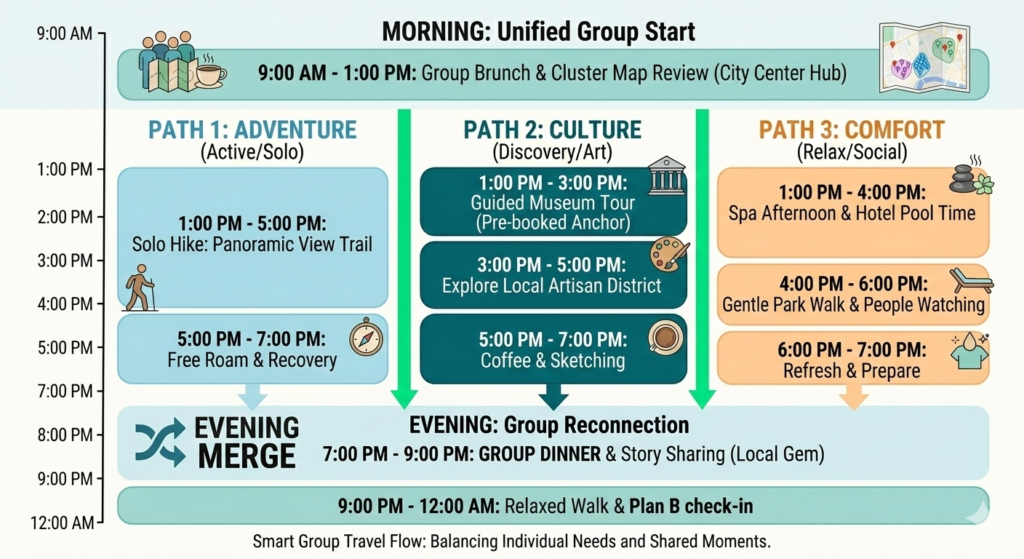
In 2026, the best trips use a “Hub and Spoke” model. You meet for a high-quality breakfast (The Hub), split up for the afternoon based on energy levels (The Spokes), and regroup for dinner to share stories.
Comparing Travel Styles: The Balance Sheet
| Personality Type | Primary Need | The Compromise |
| The Adrenaline Junkie | High Activity | 4-hour morning solo hike |
| The Comfort Seeker | Relaxation/Spa | Slow brunch + late afternoon hotel pool |
| The Culture Vulture | Museums/History | 2-hour guided tour while others shop |
2026 Tech: Collaborative Tools for Shared Sanity
Static PDFs are dead. For a truly no-argument travel experience, use live-syncing tools. We recommend checking out National Geographic’s latest insights on Multigenerational Travel to understand the shifting needs of different age groups.
- Splitwise 2.0: Don’t let money ruin friendships. Track every coffee and cab in real-time.
- Shared Interactive Maps: Let everyone drop “Interest Pins” in a shared Google Map so the group can see where the natural “clusters” of interest are.
Managing the “Travel Personality” Spectrum
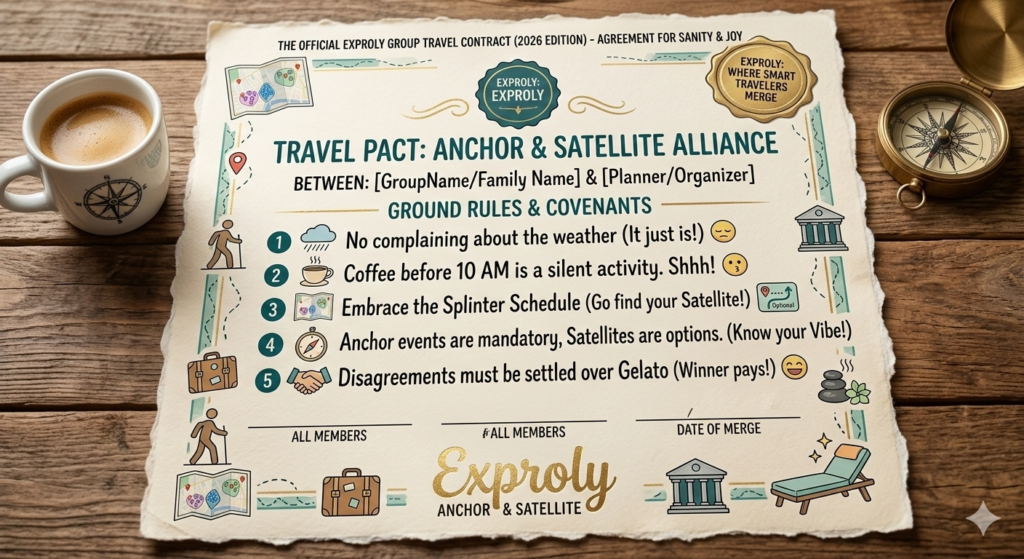
Every group has a “Planner,” a “Passenger,” and a “Complainer.” The trick is to give the Passenger a small, low-stakes job (like “Find the best gelato in this neighborhood”) and the Complainer a “Safe Space” to vent. By assigning roles, you turn the group into a team.
FAQ: Navigating the Group Travel Minefield
Q: What if our budgets are wildly different? A: Establish the “Baseline Comfort” early. Agree on a standard for accommodation (e.g., “4-star or better”) and let individuals opt-up for luxury add-ons privately if they choose.
Q: How do we handle “The Early Bird” vs. “The Night Owl”? A: Never force a 7 AM start on a Night Owl. Use the Hub and Spoke model: let the Early Birds explore while the others sleep, and meet at noon for the day’s first “Anchor Point.”
Q: Is it okay to spend a whole day apart? A: Yes! In fact, it’s often the secret to a 10/10 trip. Absence makes the dinner conversation much more interesting.