
Let’s be honest: traditional travel planning is broken. In the past, designing a week-long getaway meant spending 20+ hours drowning in a sea of browser tabs, conflicting blog posts, and outdated maps. But in 2026, smart trip planning isn’t about how much information you can gather; it’s about how quickly you can filter the noise. If you’re still manually plotting every coffee shop and train transfer, you’re working too hard.
This 2026 travel framework is designed to cut your planning time by 90% while ensuring your vacation itinerary remains flexible enough to handle the real world.
The Paradox of Choice: Why Planning Fails in 2026
The problem today isn’t a lack of info—it’s “decision paralysis.” We’ve all been there: staring at 50 “must-see” spots in Tokyo until your brain fries. The secret to an efficient travel schedule is realizing that a great trip is built on a solid architectural “skeleton,” not a rigid minute-by-minute script.
Step 1: The Cluster Mapping Method (5 Minutes)
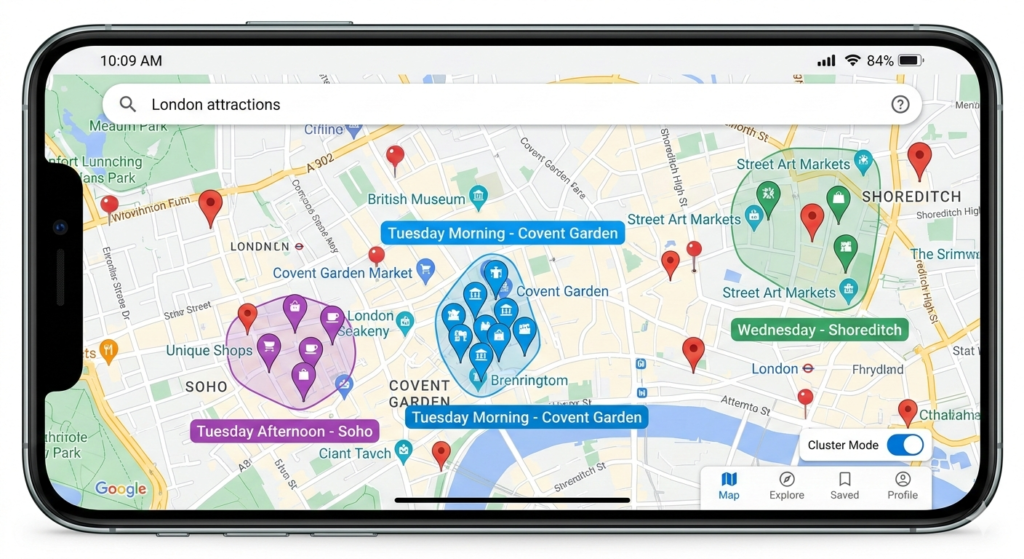
The biggest time-waster in travel is “backtracking”—traversing the same city multiple times because your spots aren’t grouped.
- The Logic: Open your map and drop pins on everything that looks remotely interesting.
- The Execution: Look for the “natural clusters.” If five of your pins are in the Latin Quarter, that is your “Tuesday.” Forget the rest for that day.
- The Result: You eliminate 30% of unnecessary transit time instantly.
Step 2: AI Scaffolding + Human Soul (10 Minutes)
In 2026, we use AI to do the “grunt work,” but we don’t let it drive the car. Use a tool like ChatGPT or Gemini to generate a “Logistical Skeleton.”
- The Prompt: “Give me a 5-day route for London focusing on Shoreditch and Soho, optimizing for walking distances.”
- The Exproly Touch: AI doesn’t know that a specific rooftop bar is closed for a private event or that a local festival is happening. This is where you inject your “Human Soul”—check 2-3 local Instagram tags or Reddit threads to verify the “vibe.”
AI vs. Smart Human Planning
| Feature | AI-Only Route | Smart Framework (Exproly) |
| Logic | Mathematical / Efficient | Experience / Mood Driven |
| Flexibility | Rigid | Includes “Buffer Zones” |
| Local Insight | General Data | Real-time / Trending |
Step 3: The Logistics Stress-Test (5 Minutes)
Your smart trip planning isn’t finished until it’s “bulletproofed.” 2026 is the year of travel volatility—flights get delayed, and weather flips.
- The Plan B Rule: For every “Anchor Activity” (like a booked museum tour), have a nearby “Low-Stakes Alternative” (a great park or a hidden bookstore).
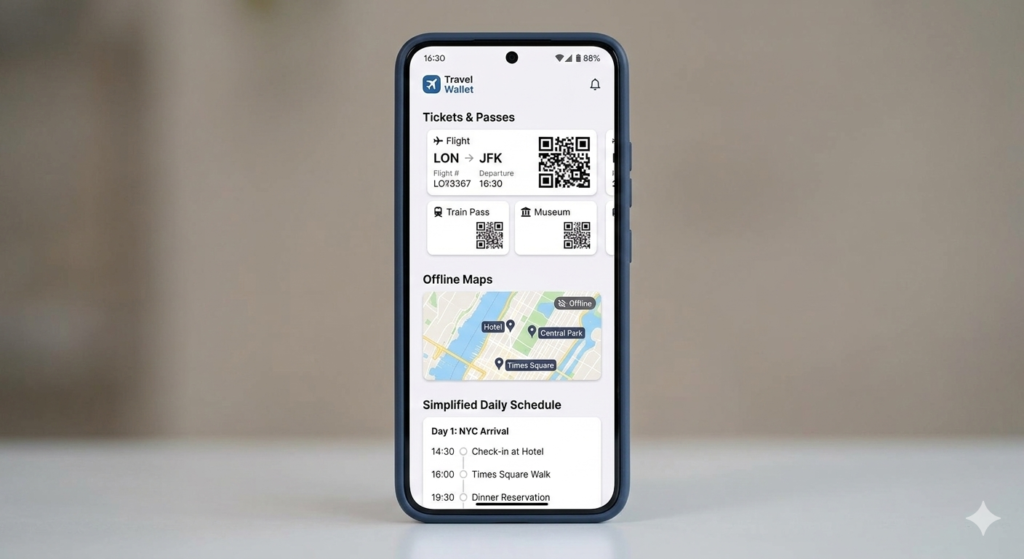
- The Digital Vault: Sync your tickets and offline maps to a single app. If the 5G drops in a remote alley, you’re still the one who knows where the hotel is.
The 2026 Recommended Toolstack
To stay under that 20-minute mark, you need the right kit. We recommend using Google Maps Platform’s Latest Features for real-time transit updates and “Immersive View” to scout locations before you even pack your bags. Combine this with a collaborative doc for your travel partners to avoid the dreaded “What do you want to do?” debate.
FAQ: Mastering the Smart Framework
Q: Is 20 minutes really enough for a 2-week trip? A: For the structure, yes. The goal is to set your “Anchor Points” (flights, hotels, and 1 major event per day). Everything else should be modular and decided on the ground.
Q: What if I’m traveling with a large group? A: Use the “Cluster Method” but give people 2 hours of “Free Roam” within the cluster. It prevents group burnout and keeps the planning simple.
Q: Which apps are best for offline navigation in 2026? A: Google Maps is still king for data, but Organic Maps is a fantastic open-source backup for privacy-conscious travelers.