
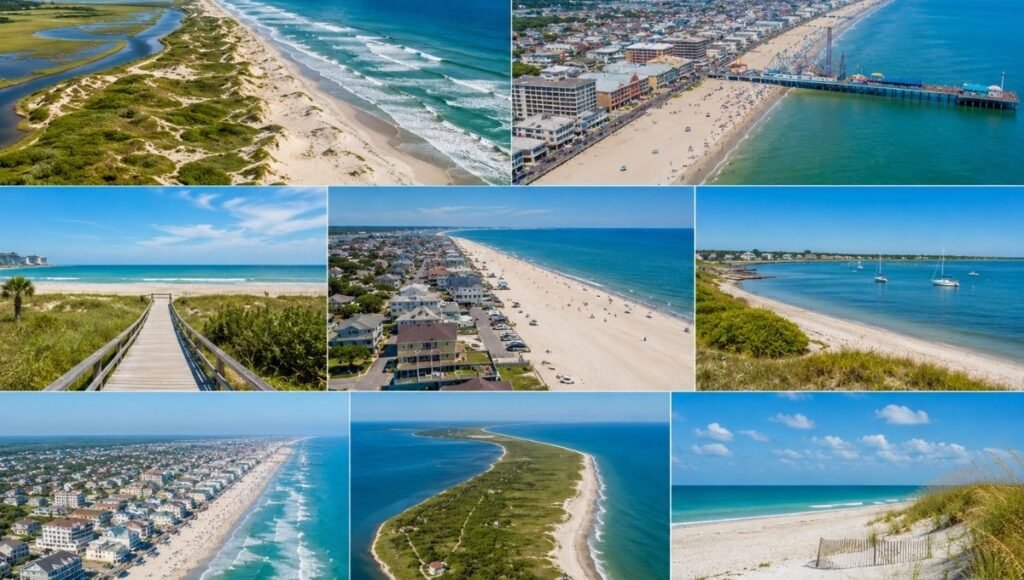
The East Coast of the United States runs 2,000 miles from the granite coves of Maine to the sugar-sand shores of Florida. Within those miles you’ll find wild horses running on windswept barrier islands, Victorian beach towns with free boardwalks, the most architecturally distinctive urban beach in the country, sand dunes tall enough to hang-glide from, and the quietest unspoiled island beaches that most people never find because they’re only accessible by ferry.
The problem with most East Coast beach guides is that they treat all of these places as interchangeable. They list 15 beaches with a paragraph each, rank them, and call it done. But a family with a seven-year-old who needs calm water for swimming has completely different needs from a family with teenagers who want surf and boardwalk energy. The Cape Cod experience is nothing like the Myrtle Beach experience, which is nothing like the Outer Banks experience — and choosing the wrong one for your family’s actual priorities is how you end up disappointed by a beach that other people love.
This guide organizes the best East Coast beaches differently — by what kind of trip you’re actually planning.
Key Takeaways
- The East Coast stretches 2,000 miles from Maine to Florida — within that range, water temperature, surf, crowd levels, beach character, and family infrastructure vary dramatically by region and by town
- For families with young children who need calm water: Cape Cod’s bay side, Hilton Head Island’s protected beaches, and Virginia Beach’s Chesapeake Bay side (Chick’s Beach) are the best options
- For families who want the classic boardwalk experience: Myrtle Beach, Ocean City (NJ or MD), and Wildwood deliver the amusement park energy; Virginia Beach and the Jersey Shore offer more measured versions
- For wild, undeveloped beach: The Outer Banks (Cape Hatteras National Seashore and Ocracoke Island) and Cape Cod National Seashore offer the longest protected shorelines on the East Coast
- September is the best month across virtually every East Coast destination — warm swimming water, reduced crowds after Labor Day, and accommodation prices that drop 30–40% from peak summer rates
How to Choose the Right East Coast Beach
Before the list, the framework. These are the questions that actually determine which beach is right for your family:
How old are your children? Young children (under 8) need calm, shallow water — the Atlantic surf on the open-coast beaches is real surf with rip currents. Bay-side beaches (Cape Cod, Chesapeake Bay side of Virginia Beach) are dramatically safer for young non-swimmers than Atlantic-facing beaches.
What’s your energy level? Boardwalk beach towns (Myrtle Beach, Ocean City, Wildwood) have constant activity and entertainment infrastructure built for keeping kids busy. Nature-focused destinations (Outer Banks, Cape Cod National Seashore, Hilton Head) require more self-direction and reward families who are comfortable with less structured activity.
What’s your budget? Miami Beach and the Hamptons are expensive. Virginia Beach, Myrtle Beach, and Wildwood are genuinely budget-accessible. Cape Cod and the Outer Banks fall in between, with the peak summer rental market pushing prices up significantly.
How far will you travel? The mid-Atlantic beaches (Virginia Beach, Ocean City, Jersey Shore) draw heavily from the DC/Baltimore/Philadelphia/New York corridors — they’re drivable from large population centers. Cape Cod requires getting through Boston traffic. The Outer Banks requires crossing causeways. Miami Beach is typically a flight destination for anyone not already in Florida.
The Best East Coast Beaches — By Region
New England
Cape Cod, Massachusetts — The Bay vs. Atlantic Decision
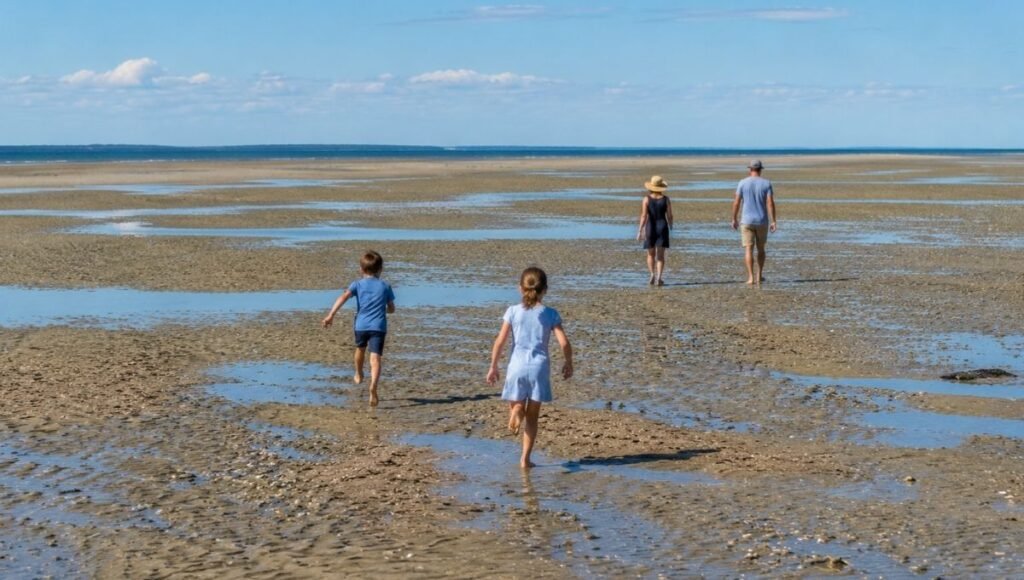
Cape Cod is genuinely one of the best family beach destinations on the East Coast, but it requires understanding before you arrive. The Cape has two completely different ocean environments side by side — the calm, warm, shallow Cape Cod Bay on the inside curve, and the dramatic open-Atlantic beaches of the Cape Cod National Seashore on the outside.
The bay beaches at Brewster, Dennis, and Yarmouth are ideal for families with young children — warm, shallow, calm, and at low tide they reveal tidal flats that extend nearly a mile where kids can explore, collect shells, and watch hermit crabs without any depth risk. The Brewster Flats are one of the most genuinely unique family beach experiences on the entire East Coast.
The Atlantic-side National Seashore beaches — Coast Guard Beach, Nauset Light, Herring Cove — are dramatic, wide, wild, and appropriate for older, confident swimmers. The surf is real. The U.S. News-rated #1 beach in the country (Coast Guard Beach in Eastham) is on this side.
Best for: Families wanting the full New England beach experience. Children 8+ can handle both sides; younger children should stay on the bay.
The logistics everyone gets wrong: Most town beaches require a resident parking sticker. The six Cape Cod National Seashore beaches charge $25/day per vehicle (2026) and are open to all visitors — they’re also the most beautiful beaches on the Cape.
Great white sharks are present near Cape Cod’s Atlantic beaches — particularly near seal colonies. Download the Atlantic White Shark Conservancy’s Sharktivity app before swimming on the outer beaches. The risk is real but manageable with awareness.
→ Full guide: Cape Cod Beaches: The Honest Family Guide
Mid-Atlantic
Virginia Beach, Virginia — The City Beach That Works for Everyone
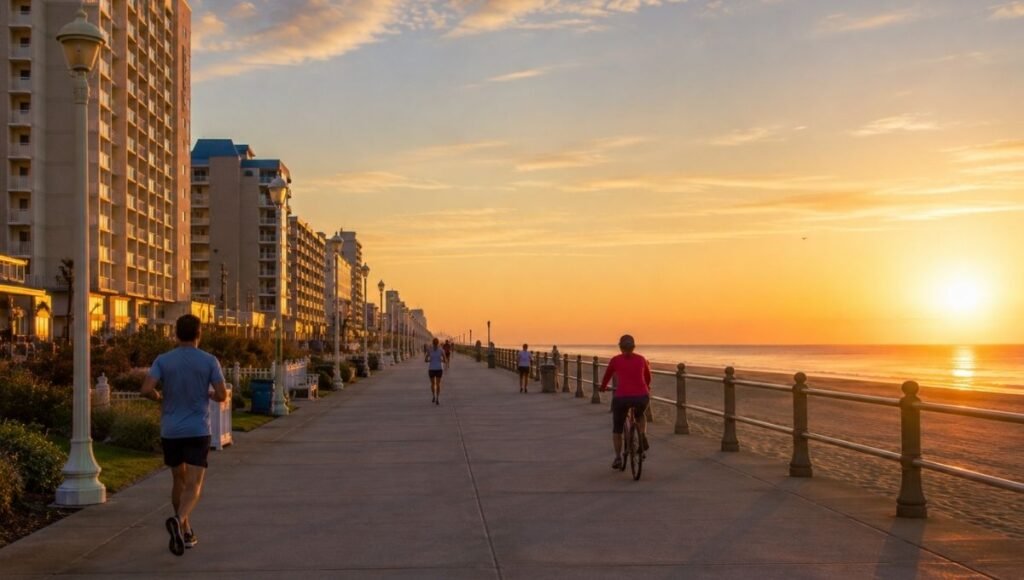
Virginia Beach was named one of the top places to visit in 2026 by The New York Times, and the city’s beach infrastructure has genuinely improved in recent years. The three-mile Virginia Beach Boardwalk runs from 2nd to 40th Streets along the Oceanfront — it’s paved concrete (not wood), has a dedicated bike lane, and serves as the backbone of the resort area.
What most visitors don’t know: Virginia Beach has 38 miles of coastline, not just the Oceanfront strip. The bay side of the peninsula — Chick’s Beach on the Chesapeake Bay — offers calm, warm, shallow water ideal for young children, completely different from the Atlantic surf of the main beach. First Landing State Park at the northern end of the city has 20 miles of trails through bald cypress swamp and a bay beach, and it’s where English colonists first landed in 1607 before establishing Jamestown.
Grommet Island Park at 40th Street is America’s first fully accessible beach playground — designed for children of all abilities. The ViBe Creative District around 19th Street has murals, contemporary art, and restaurants that aren’t simplified for tourist crowds.
Best for: Families wanting a city beach with diverse options — active Boardwalk for kids who need entertainment, quieter bay beaches for young swimmers, nature experiences at First Landing State Park.
Timing: September is the consensus best month — water stays at 72–74°F, hotel rates drop 40% from July peak.
→ Full guide: Things to Do in Virginia Beach: The Honest Family Guide
Jersey Shore, New Jersey — America’s Classic Boardwalk Experience
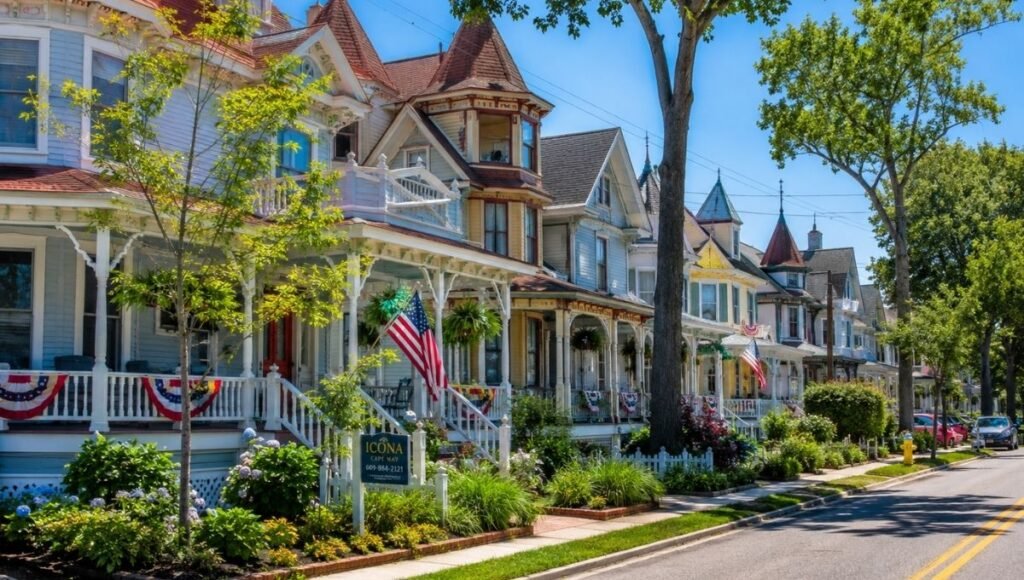
The Jersey Shore stretches 130 miles from Sandy Hook to Cape May, and within those miles you’ll find the full range of East Coast beach experiences. Ocean City NJ — dry since 1879, no alcohol sold anywhere — is one of the most genuinely family-focused beach destinations on the entire coast. Wildwood has the widest free beach on the Jersey Shore (five miles, no badge required) and Morey’s Piers, the most extensive boardwalk amusement park complex in the mid-Atlantic. Cape May at the southern tip is a National Historic Landmark District of Victorian architecture — completely different in character from the rest of the Shore.
Most New Jersey town beaches charge a daily badge fee ($5–$15 in 2026), with free beach access at Wildwood, Atlantic City, Cape May Point, and Sandy Hook. The badge system confuses first-time visitors — the National Park beaches (Sandy Hook) and the Wildwoods are the simplest for visitors who don’t want to navigate town-specific rules.
Best for: The classic mid-Atlantic boardwalk experience. Ocean City for dry-town family focus. Wildwood for maximum amusement park and free beach. Cape May for Victorian charm and whale watching.
→ Full guide: Jersey Shore Beaches: The Honest Family Guide
Outer Banks, North Carolina — Wild Beach at Its Best

The Outer Banks is 130 miles of barrier island that genuinely feels different from any other beach destination on the East Coast. No high-rise hotels above the tree line, no resort tower skyline, wild Spanish mustang horses running free on the northern beaches of Corolla and Carova, Cape Hatteras National Seashore protecting over 70 miles of undeveloped Atlantic coastline, and Ocracoke Island at the southern tip — accessible only by ferry, consistently ranked among the most pristine beaches in the country.
The Outer Banks rewards families who come for the natural experience rather than the resort experience. Duck is the quietest and most upscale of the beach towns. Kill Devil Hills is the central hub with the Wright Brothers National Memorial. The Cape Hatteras Lighthouse at 198 feet is the tallest brick lighthouse in the country. The Outer Banks is also the best surf destination on the East Coast — the Point at the southern tip of Hatteras Island is a legendary break.
Best for: Families who want the wild, undeveloped East Coast beach experience. Nature lovers. Surfing families. Anyone who’s done Myrtle Beach or Virginia Beach and wants something fundamentally different.
The logistics: The Outer Banks is accessible by a single causeway system — Saturday summer traffic can be significant. No large commercial airport on the island — the nearest are Raleigh-Durham (3 hours) and Norfolk (1.5 hours to the northern OBX).
→ Full guide: Outer Banks Beaches: The Complete OBX Guide
The South
Myrtle Beach, South Carolina — The Family Entertainment Beach
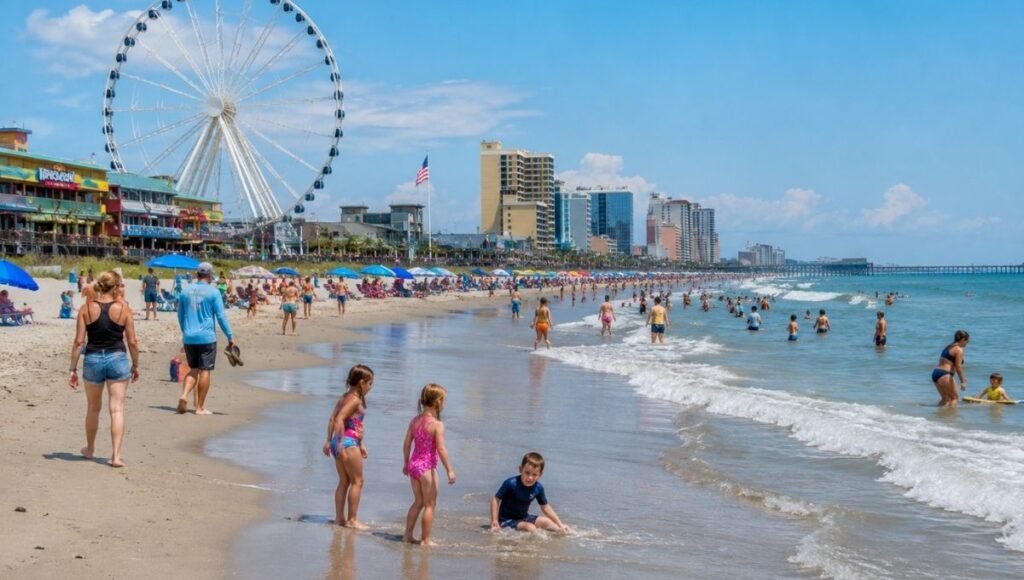
Myrtle Beach is what it is, unapologetically — a beach entertainment destination built specifically for family vacations. Sixty miles of wide Atlantic beach, the 1.2-mile Myrtle Beach Boardwalk, Ripley’s Aquarium at Broadway at the Beach, WonderWorks, Brookgreen Gardens, dolphin cruises, and enough mini golf courses per square mile to have made it something of a regional institution. The sheer density of family activities means you can fill five days without repeating yourself.
Myrtle Beach State Park, three miles from the main strip, is the most underrated asset in the entire area — 312 acres of maritime forest with a pristine park beach and hiking trails, far quieter than the Boardwalk area. The Golden Mile section north of 31st Avenue N has the same beach with significantly fewer crowds.
Best for: Families who want maximum activity infrastructure. The 6–14 age range specifically — old enough for the amusement attractions, young enough to be genuinely thrilled by them.
Timing: September is the sweet spot — water warm at 78°F+, summer crowds gone, accommodation prices drop 30–40%.
→ Full guide: Things to Do in Myrtle Beach SC: The Honest Family Guide
Hilton Head Island, South Carolina — Old-Growth Forest Meets Atlantic Beach
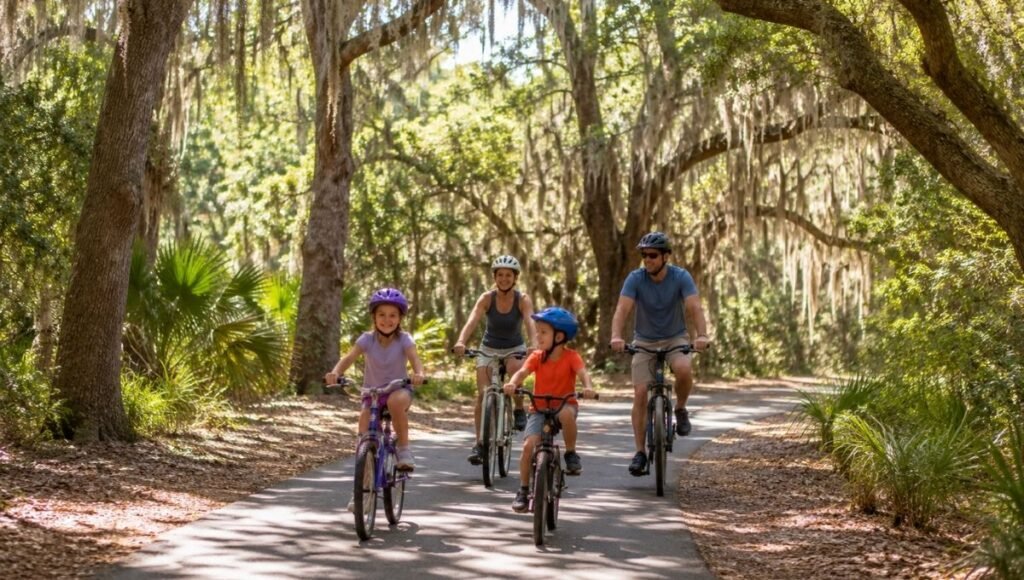
Hilton Head’s defining characteristic is what you don’t see when you arrive: no high-rise buildings visible above the tree canopy. Strict building codes passed decades ago require all development to sit behind the tree line, and a 35-foot height limit means the island skyline is live oaks and palms rather than resort towers. The result is a beach destination that looks and feels fundamentally different from the typical resort coast — more like a nature preserve that happens to have excellent beach infrastructure.
The island has 60+ miles of paved bike paths running through maritime forest, and cycling is genuinely practical family transportation rather than just recreation. The tidal creek system on the back side of the island is where the island’s resident bottlenose dolphins actually live — kayak tours through the creeks produce remarkably reliable wildlife encounters. The Harbour Town Lighthouse at Sea Pines Plantation is the island’s most recognizable landmark.
Best for: Families who want outdoor activities alongside the beach — cycling, kayaking, wildlife. Families seeking a quieter, more nature-oriented alternative to Myrtle Beach.
→ Full guide: Things to Do in Hilton Head: The Honest Family Guide
Miami Beach, Florida — The Urban Beach Experience
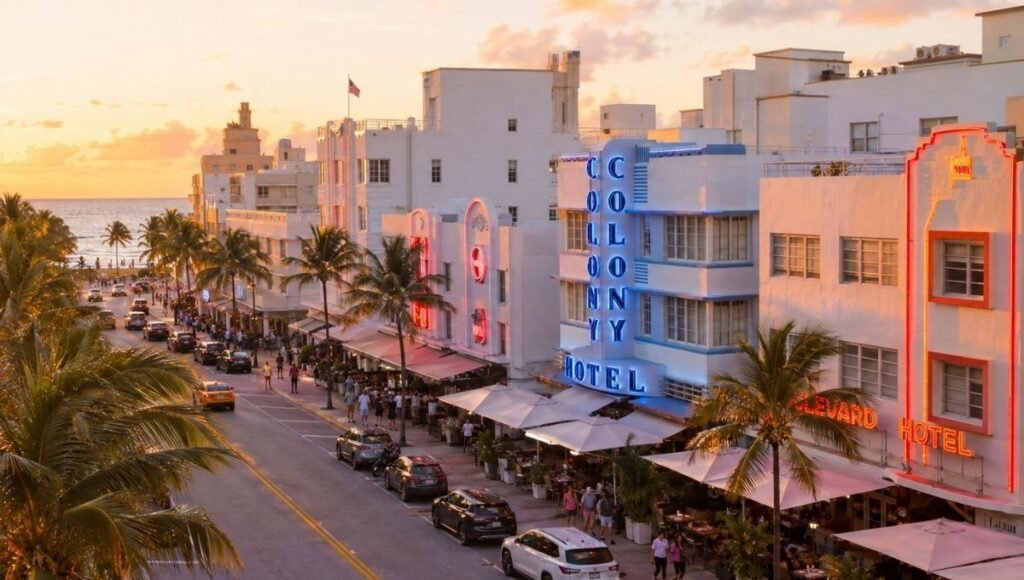
Miami Beach is categorically different from every other beach on this list. It’s a city with a beach, not a beach town — and understanding that distinction before you arrive is what determines whether you have a great trip or a confusing one.
The beach itself — South Beach — is genuinely extraordinary: wide, warm, turquoise-to-emerald Atlantic water, and the backdrop of the Art Deco Historic District that makes it visually unlike any other beach in the world. The three-mile boardwalk runs from South Pointe north past Lummus Park. Grommet-Island-equivalent for Miami: Lummus Park between 5th and 14th Streets, with playground equipment directly adjacent to beach access and the iconic pastel lifeguard stands.
What Miami Beach does uniquely: the Art Deco District on Ocean Drive, South Pointe Park at the southern tip, Lincoln Road for dining, the ViBe-equivalent ViBe-equivalent creative scene in Wynwood (a short drive). Ocean Drive is worth walking once for the architecture — but don’t eat there, the prices are tourist-inflated and the quality rarely matches.
Best for: Families with older children (8+) who can engage with the city’s cultural energy alongside the beach. Winter escape for northern families — Miami Beach is warm and swimmable when New England and the mid-Atlantic are cold.
Timing: October–November is the sweet spot — ocean still 80°F+, summer crowds gone, prices down 20–35% from peak.
→ Full guide: Things to Do in Miami Beach: The Honest Family Guide
East Coast Beach Comparison — Quick Reference
| Beach | Best For | Surf Level | Crowd Level | Badge/Fee |
|---|---|---|---|---|
| Cape Cod (bay side) | Young children, tidal flats | Calm | Medium | $25/day NPS or town badge |
| Cape Cod (Atlantic side) | Older swimmers, drama | Moderate | Medium | $25/day NPS |
| Virginia Beach Oceanfront | All ages, boardwalk | Moderate | High | Free |
| Virginia Beach (Chick’s) | Young children, calm water | Calm | Low | Free |
| Jersey Shore (Ocean City) | Family boardwalk, dry town | Moderate | High | $5/day badge |
| Jersey Shore (Wildwood) | Budget families, amusements | Moderate | Very High | Free |
| Jersey Shore (Cape May) | History, Victorian charm | Moderate | Medium | $8/day badge |
| Outer Banks | Wild beach, nature | Moderate–High | Low–Medium | Free (NPS permit for driving) |
| Myrtle Beach | Family entertainment | Moderate | High | Free |
| Hilton Head | Cycling, wildlife, nature | Moderate | Medium | Free |
| Miami Beach | Urban culture + beach | Moderate | High | Free |
Best East Coast Beaches for Families — By Age Group
Families with Children Under 6
First choice: Cape Cod bay side — the Brewster Flats at low tide are unlike anything else on the East Coast. Shallow, warm, calm, and the tidal flat exploration element keeps young children engaged in a way that standard beach sitting doesn’t.
Second choice: Virginia Beach Chesapeake Bay (Chick’s Beach) — bay water so calm and shallow that very young children can wade confidently.
Third choice: Hilton Head — the island’s beaches have manageable surf and the clear kayak mangrove tours work for children 5+ with a parent.
Families with Children 6–12
This is the age range that benefits most from boardwalk beach towns with amusement infrastructure.
Myrtle Beach has the most complete activity infrastructure for this age — Ripley’s Aquarium, WonderWorks, boardwalk amusements, dolphin cruises, Brookgreen Gardens.
The Outer Banks is the best nature choice for this age range — the wild horse tours, the Cape Hatteras Lighthouse climb, Ocracoke Island ferry, and the Wright Brothers Memorial all land well with children who are curious about history and wildlife.
Virginia Beach works across the range — Grommet Island Park for younger children, Virginia Aquarium, Atlantic Fun Park, and First Landing State Park for older children.
Families with Teenagers
Teenagers want surf, autonomy, and experiences that don’t feel orchestrated by parents.
The Outer Banks for surf — the Point at Hatteras Island is the best break on the East Coast, and the OBX has a genuine surf culture.
Miami Beach for cultural energy — the Art Deco District, the South Beach scene, and the city’s food and creative culture are engaging for teenagers who’ve outgrown pure beach time.
Jersey Shore (Asbury Park) for arts and music — Asbury Park’s revival has produced a genuinely interesting beach town with concerts, murals, and food that works for teenagers.
The Atlantic Surf Reality — What Parents Need to Know
Every East Coast beach on the Atlantic side has real surf and real rip currents. This is not the Gulf of Mexico. The United States Lifesaving Association documents significant rescue activity at virtually every Atlantic-facing beach on this list every summer.
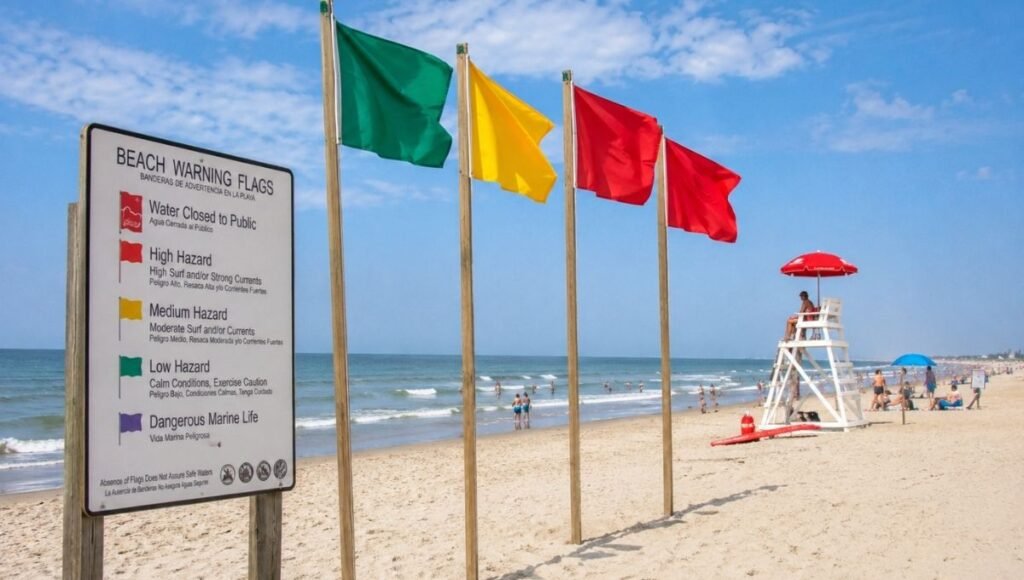
Before any Atlantic beach visit with children:
Teach the rip current response before you arrive — swim parallel to shore rather than against the current. The rip is narrow; swimming sideways exits it. Explain that the water pulling you sideways is the signal, not a reason to panic.
Check the beach flag system every morning before entering the water. Green means low hazard. Yellow means caution. Red means dangerous conditions — don’t enter with children. Double red means water is closed.
Swim only in lifeguarded sections during lifeguarded hours. Virtually every major beach on this list has lifeguard coverage in designated areas during summer season. Use those sections with children.
The CDC’s water safety guidelines recommend that children who are not strong swimmers wear US Coast Guard-approved personal flotation devices in open water — not pool floaties, proper PFDs. This is particularly relevant at Atlantic beaches where the surf adds an unpredictable element that pool swimming doesn’t prepare children for.
Best Time to Visit East Coast Beaches
The single most consistent answer across every destination on this list is September.
After Labor Day, school resumes and the family crowds thin. But the ocean is actually at its warmest in September — it’s been absorbing summer heat all season, and water temperatures peak in August and stay warm through September. Hotel rates drop 30–40% from July peaks at virtually every destination. Beaches are noticeably less crowded. Restaurants don’t need advance reservations.
Destination-specific timing:
Cape Cod: September and late June. Avoid July–August peak if crowd sensitivity matters. The week after Labor Day on Cape Cod is a different experience from Labor Day weekend.
Virginia Beach: September is the consensus pick — water 72–74°F, 40% price drop from July.
Outer Banks: October is the local favorite — fall fishing season, dramatic skies, the Cape Hatteras lighthouse in autumn light. September is crowded by OBX standards; October is genuinely quiet.
Myrtle Beach: September — same beach quality at dramatically lower prices.
Hilton Head: September and October — warm water, low crowds, excellent conditions for cycling and kayaking. November is also excellent.
Miami Beach: October–November — warm ocean, reduced crowds from summer, prices below peak. December through February is Miami Beach’s peak season and genuinely beautiful if budget allows.
Jersey Shore: September. The weekend after Labor Day, the Shore exhales.
Frequently Asked Questions
What is the best East Coast beach for families? It depends on what your family actually needs. For young children who need calm water: Cape Cod’s bay side and Virginia Beach’s Chesapeake Bay side (Chick’s Beach). For families who want boardwalk entertainment: Myrtle Beach for maximum activity density, Virginia Beach for a more measured version. For families who want nature and wild beach: the Outer Banks. For families who want cultural depth alongside the beach: Miami Beach or Cape May.
What are the best East Coast beaches for families with young kids? Cape Cod bay-side beaches (Brewster Flats, Mayflower Beach in Dennis) for shallow, warm, calm water with tidal flat exploration. Virginia Beach’s Chesapeake Bay side (Chick’s Beach) for flat, shallow bay water. Hilton Head for gentle Atlantic surf and excellent outdoor infrastructure. All three have meaningfully calmer water than the main Atlantic-facing beaches at Myrtle Beach, Virginia Beach Oceanfront, or the Outer Banks.
What is the best East Coast beach town? For Victorian charm and unique character: Cape May, New Jersey — a National Historic Landmark District with free beaches at Cape May Point. For Old Florida character on the East Coast: the Outer Banks towns, particularly Duck and Ocracoke. For boardwalk culture: Ocean City (MD) or Wildwood. For arts and revival energy: Asbury Park, NJ and the ViBe District in Virginia Beach.
When is the best time to visit East Coast beaches? September, consistently. Water stays warm from summer (70–78°F across the coast), crowds reduce significantly after Labor Day, and accommodation prices drop 30–40% from July peak. Late June is the second best window — post-spring break, pre-peak, with warming water and operational facilities.
Are East Coast beaches safe for swimming? Yes, in lifeguarded sections during lifeguarded hours. The Atlantic surf at open-coast beaches is real and produces rip currents — the appropriate response is to swim parallel to shore rather than directly toward it. Check beach flag conditions before entering. Young children and non-swimmers should use US Coast Guard-approved PFDs in Atlantic surf. Bay-side beaches (Cape Cod bay, Chesapeake Bay in Virginia Beach) have no significant wave action and are substantially safer for young children.
What is the best East Coast beach for a week-long family vacation? The Outer Banks offers the most complete week-long family experience — enough distinct beach sections (Duck, Kill Devil Hills, Hatteras, Ocracoke by ferry), natural attractions (wild horses, Cape Hatteras Lighthouse, Wright Brothers Memorial, Cape Hatteras National Seashore), and activity range to fill a full week without repetition. Myrtle Beach is the alternative for families who want maximum entertainment infrastructure. Cape Cod works best for families willing to explore multiple towns across the week.
The Bottom Line
The best East Coast beach isn’t a single place — it’s the one that matches what your family actually needs from a beach vacation. The Atlantic coast delivers everything from the wild and remote (Ocracoke Island, Cape Hatteras National Seashore) to the fully developed and entertainment-packed (Myrtle Beach, Ocean City). Between those poles are beach towns with genuine character — Cape May’s Victorian streets, the Outer Banks’ wild horse country, Hilton Head’s live-oak canopy, Cape Cod’s tidal flats.
Use the framework. Match the destination to the ages of your children, your appetite for activity versus nature, your budget, and how far you’re willing to travel. Then go in September.
The Atlantic will do the rest.
Explore our complete guides for each destination:
- Cape Cod Beaches: The Honest Family Guide
- Things to Do in Virginia Beach: The Honest Family Guide
- Jersey Shore Beaches: The Honest Family Guide
- Outer Banks Beaches: The Complete OBX Guide
- Things to Do in Myrtle Beach SC: The Honest Family Guide
- Things to Do in Hilton Head: The Honest Family Guide
- Things to Do in Miami Beach: The Honest Family Guide
- What to Bring to the Beach: Complete Beach Gear Guide
- Jellyfish Sting Treatment & Beach Safety Guide
References
- U.S. News & World Report — Best Beaches Rankings 2026
- The New York Times — Top Places to Visit 2026 (Virginia Beach listing)
- Cape Cod National Seashore — National Park Service: nps.gov/caco
- Atlantic White Shark Conservancy — Sharktivity App: atlanticwhiteshark.org
- United States Lifesaving Association — Beach Safety Statistics: usla.org
- CDC — Water Safety Guidelines for Open Water Swimming: cdc.gov/drowning
- Corolla Wild Horse Fund — Wild Horse Protection: corollawildhorses.com