
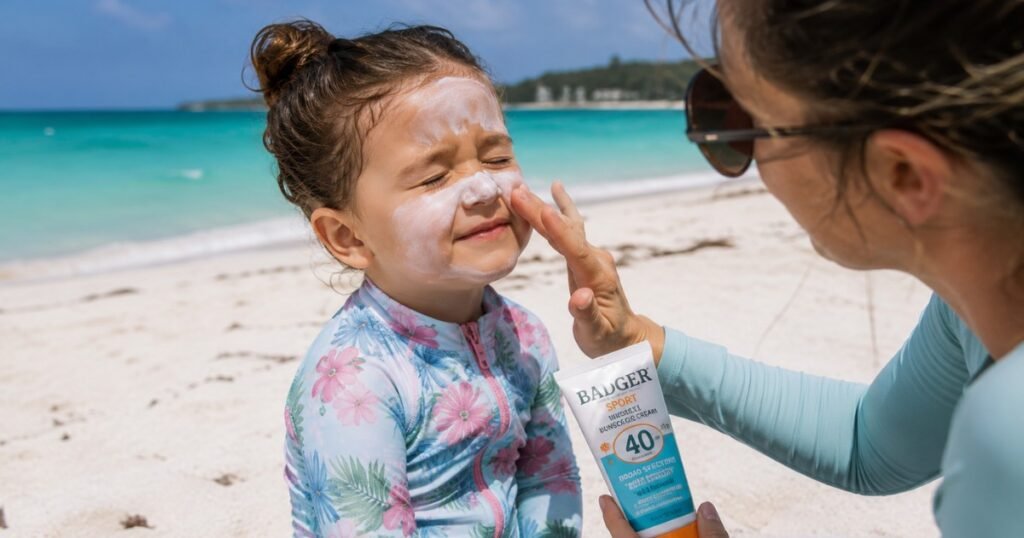
I was standing in the sunscreen aisle at Target three summers ago, twenty minutes before we were supposed to leave for the beach, staring at a wall of bottles covered in green leaves and ocean waves and the words “reef safe” printed in confident font across what felt like every single product. My daughter was asking if we could go already. My son had already put on his water shoes.
I grabbed two bottles that looked official, threw them in the cart, and didn’t think about it again until I started reading about Hawaii’s sunscreen ban on the flight home. Turns out “reef safe” is not a regulated term. The FDA doesn’t define it. Brands print it on bottles because it sells — not because any certifying body has verified the claim. Some of the bottles I’d bought were genuinely reef-safe. Others were not, even though both said they were.
We all want to protect coral reefs—but nobody wants sunscreen running into a child’s eyes halfway through a beach day. This guide is for you. I’ve spent time testing products with my own kids and researching the actual ingredients that matter. What you’ll find here is a clear explanation of what makes a sunscreen genuinely reef-safe, which products I’d actually pack, and how to use them in a way that works for real beach days with real children.
Quick Picks: Best Reef Safe Sunscreens for Families
- Best Overall: Badger Sport Mineral Sunscreen SPF 40
- Best for Kids: Babo Botanicals Sheer Mineral Lotion SPF 50
- Best for Babies: Thinkbaby Safe Sunscreen SPF 50+
- Best for Sensitive Skin: Blue Lizard Sensitive Mineral Sunscreen SPF 50+
- Best Budget: Hello Bello Mineral Sunscreen SPF 50
- Best Sport: Raw Elements Eco Formula SPF 30
- Best Face Stick: Blue Lizard Face Mineral Stick SPF 50+
- Best Tinted: Badger Tinted Mineral Sunscreen SPF 30
What Makes a Sunscreen Truly Reef Safe?
Editor’s Note
Every sunscreen on the shelf can look “reef safe,” but labels don’t always tell the full story. Before you choose one for your next beach trip, it’s worth understanding which ingredients actually help protect coral reefs—and which claims are mostly marketing.
Why the “Reef Safe” Label Isn’t Regulated
Here’s the thing nobody tells you at the point of purchase: the phrase “reef safe” has no legal definition in the United States. The FDA regulates sunscreen as an over-the-counter drug — it evaluates SPF accuracy, water resistance claims, and broad-spectrum coverage. What it does not do is certify or regulate environmental claims like “reef safe,” “ocean friendly,” or “reef conscious.”
This means any brand can print any of those phrases on their bottle without meeting a single external standard. The marketing team decided it was reef safe. That’s it.
The scientific basis for concern about certain sunscreen ingredients is real and documented. A 2016 study published in the journal Archives of Environmental Contamination and Toxicology by Dr. Craig Downs found that oxybenzone and octinoxate cause coral bleaching, DNA damage, and developmental abnormalities in coral larvae at concentrations as low as 62 parts per trillion — the equivalent of one drop in 6.5 Olympic swimming pools. Hawaii, the US Virgin Islands, Palau, and other reef-dependent destinations banned these ingredients specifically based on this research.
How Greenwashing Confuses Parents
Greenwashing in the sunscreen aisle is sophisticated. Products with oxybenzone will sometimes carry “reef safe” labels if they’ve removed octinoxate. Products that removed both of the banned ingredients may still contain other concerning compounds — octisalate, octocrylene, homosalate — that some researchers flag as potentially harmful to marine ecosystems even if they haven’t been banned yet.
The visual language of reef safety — ocean imagery, green packaging, “natural” fonts — exists independently of the actual ingredients. I’ve held bottles that looked identical in terms of eco-branding that had completely different active ingredient lists.
The One Thing to Check Before Buying
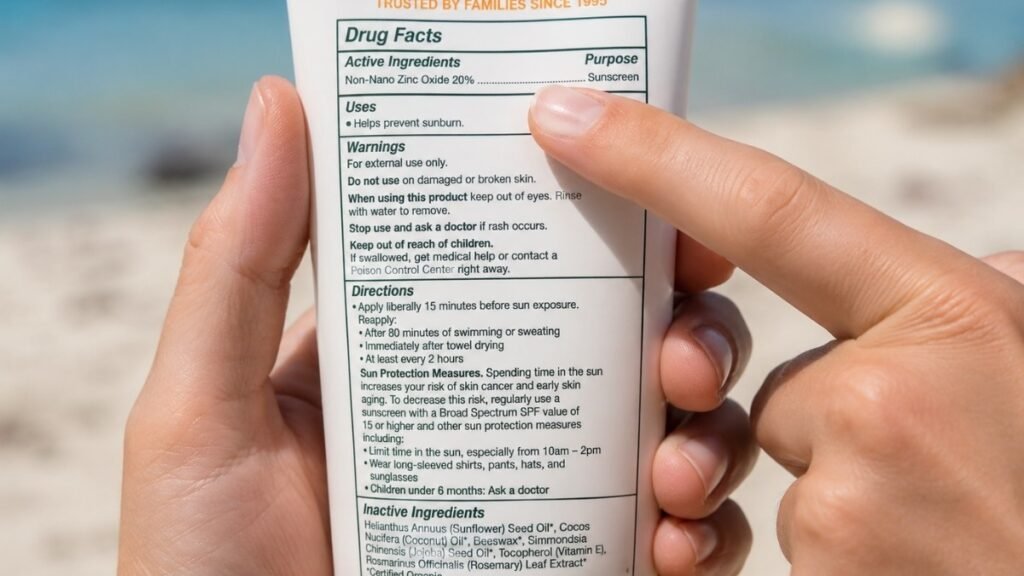
Skip the label claims entirely. Turn the bottle over and read the active ingredients panel.
You’re looking for one of two things:
Non-nano zinc oxide — the gold standard for reef safety. Non-nano means the particles are large enough that they don’t penetrate coral tissue or cell walls. Zinc oxide physically reflects UV rays rather than absorbing and converting them chemically.
Titanium dioxide — a secondary mineral option that’s also reef-safe and tends to produce slightly less white cast than zinc oxide, though it provides slightly less UVA coverage.
If the active ingredients list anything other than zinc oxide, titanium dioxide, or a combination of the two — if you see oxybenzone, octinoxate, avobenzone, octisalate, octocrylene, or homosalate — it’s a chemical sunscreen, regardless of what the front of the bottle says.
That’s the whole check. Active ingredients panel. Non-nano zinc oxide or titanium dioxide. Done.
Chemical vs. Mineral Sunscreen: Which One Is Better for Families?
This question comes up constantly, and the honest answer is that for families spending time on coral reef beach destinations, mineral is the right choice — not because chemical sunscreens are universally dangerous, but because the specific beach environments that make a destination worth visiting are the same ones that chemical sunscreen ingredients damage.
How Chemical Sunscreens Work
Chemical sunscreens use UV-absorbing compounds — oxybenzone, avobenzone, octinoxate, and others — that penetrate the outer skin layers and convert UV radiation into heat, which is then released from the skin. They’re generally lightweight, sheer, and easy to apply, which is why they’ve dominated the market for decades.
The absorption is the issue. Studies show that chemical sunscreen ingredients are absorbed into the bloodstream within minutes of application, and the FDA has acknowledged that the systemic absorption of most chemical filters exceeds its own safety threshold — prompting a call for more research. For children with higher skin surface-area-to-body-weight ratios, the absorption concern is proportionally greater.
How Mineral Sunscreens Work
Mineral sunscreens sit on top of the skin and physically deflect UV rays — they don’t absorb into skin or bloodstream in meaningful amounts. Non-nano zinc oxide specifically has been continuously used since the 1940s, has an extensive safety record, and is the only active ingredient the FDA has proposed categorizing as “generally recognized as safe and effective” for daily use.
The trade-off is texture. Mineral sunscreens are thicker, can leave a white cast particularly on deeper skin tones, and historically required more effort to rub in. Modern formulations have improved significantly on this front — the gap between chemical and mineral in terms of application experience is much narrower than it was five years ago.
Which One Is Easier on Sensitive Skin?
Mineral, consistently. The most common cause of sunscreen-related skin reactions in children — stinging, redness, rash — is fragrance and chemical UV filters. Fragrance-free mineral sunscreens with non-nano zinc oxide are the standard recommendation for children with eczema, sensitive skin, or any history of sunscreen reactions.
Which One Is Better for Kids at the Beach?
For beach use specifically, mineral wins on two fronts: it’s reef-safe for any snorkeling or swimming near coral, and it’s better tolerated on children’s skin for the extended, repeated application that a full beach day requires.
Quick Comparison:
| Mineral (Zinc Oxide/Titanium Dioxide) | Chemical | |
|---|---|---|
| Reef safe | ✅ Yes | ❌ Most are not |
| Skin absorption | Minimal | Significant |
| Sensitive skin | ✅ Better | ⚠️ More reactions |
| White cast | Some (improving) | None |
| Water resistance | ✅ 80 min available | ✅ 80 min available |
| FDA safety status | GRASE proposed | Under review |
| Best for kids | ✅ Yes | ⚠️ Concerns |
Ingredients to Avoid Before Your Next Beach Trip
“Reef safe” conversations usually stop at oxybenzone and octinoxate because those are the ones that are banned in certain jurisdictions. But the full list of ingredients worth avoiding is longer — and some of them appear in products that otherwise market themselves as reef-friendly.
| Ingredient | Why Avoid | Specific Family Concern |
|---|---|---|
| Oxybenzone | Coral bleaching at 62 ppt; banned in Hawaii, USVI, Palau | Hormone-disrupting properties; high skin absorption |
| Octinoxate | Coral tissue toxicity; banned alongside oxybenzone | Endocrine disruption concerns; found in breast milk in studies |
| Octocrylene | Accumulates in coral tissue; may degrade to benzophenone | Possible hormone disruption; found in blood and breast milk |
| Avobenzone | Environmentally persistent; some coral toxicity data | Degrades in sunlight without stabilizers; may cause reactions |
| Homosalate | Disrupts coral hormone systems | FDA flagged for systemic absorption above safe threshold |
| Octisalate | Mild coral toxicity concerns | Helps stabilize avobenzone; not independently reef-safe |
| Nano-particles | Penetrate coral cells at nano scale | Even zinc oxide in nano form may cause coral damage |
| Added Fragrance | No reef safety concern directly | Most common cause of sunscreen reactions in children |
| Parabens | Some aquatic toxicity data | Endocrine disruption concerns for children |
The practical takeaway: if it’s not non-nano zinc oxide or titanium dioxide, ask why it’s in the formula before accepting the reef-safe claim on the front label.
Best Reef Safe Sunscreens for Families (2026 Reviews)
Best Overall — Badger Sport Mineral Sunscreen SPF 40
Badger’s Sport formula earned best overall from Treeline Review’s 2026 reef-safe sunscreen evaluation, and the reasons are straightforward: only four ingredients (22.5% uncoated non-nano zinc oxide, sunflower oil, beeswax, and vitamin E), genuine 80-minute water resistance, minimal white cast for a zinc oxide formula, and a price point that makes reapplication feel financially painless.
The simplicity of the ingredient list is a feature, not a limitation. Four ingredients means essentially no chance of an unexpected skin reaction in children, and the absence of fragrance makes it appropriate for sensitive skin.
Texture: Thicker than chemical sunscreens but rubs in reasonably well when warmed between palms first. Not invisible, but not the ghost-face scenario either.
White cast: Minimal to moderate — more visible on deeper skin tones, manageable for most complexions.
Water resistance: 80 minutes, genuinely tested.
Easy to reapply: Yes — the tube format dispenses predictably, and the formula doesn’t require a lot of rubbing to distribute.
Best for: Families who want maximum ingredient simplicity and proven reef safety in a sport formula that holds up through swimming.
✔ Only 4 ingredients — lowest allergy risk ✔ 80-minute water resistance ✔ Non-nano zinc oxide verified ✔ Woman-owned, B-Corp certified, made in USA ✘ Thicker texture requires warmup before application ✘ Not the most affordable per ounce
Best for Kids — Babo Botanicals Sheer Mineral Lotion SPF 50
Project Reef’s 2026 rankings named Babo Botanicals their best-for-kids pick, describing it as “gentle enough for babies but effective enough for adults.” The sheer mineral formula uses non-nano zinc oxide with plant-based ingredients, is fragrance-free, and is specifically formulated to minimize the white cast that makes mineral sunscreen application a battle with young children.
The sheer formulation matters practically: when a sunscreen goes on more invisibly, kids are less resistant to it, and parents are less tempted to under-apply because it looks like they’re painting their child white.
Texture: Lighter than most zinc oxide formulas. Noticeably easier to blend.
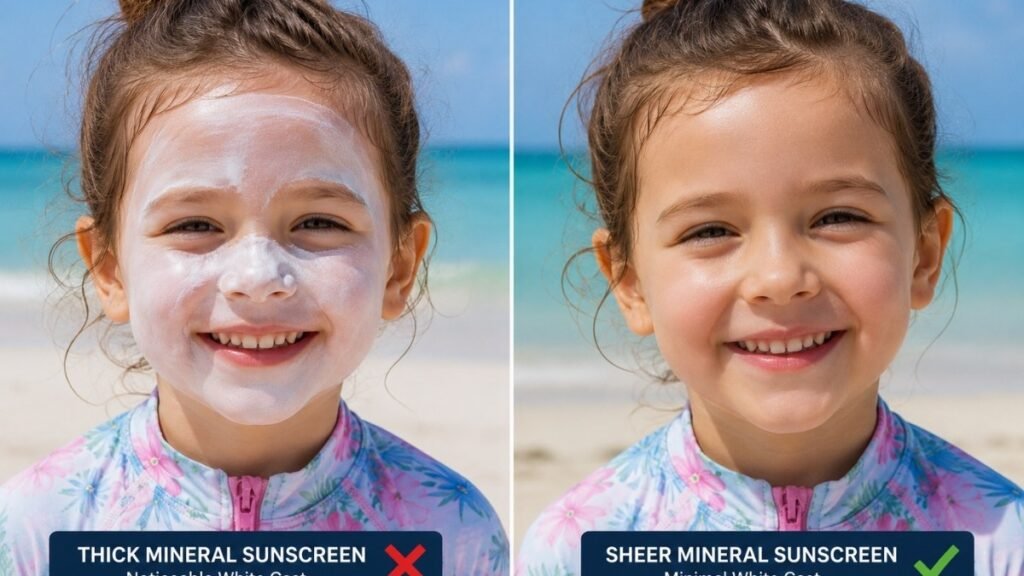
White cast: Low — the best in this category for reducing cast on children’s skin.
Water resistance: 80 minutes.
Easy to reapply: Yes — the lighter texture makes mid-beach reapplication less of a production.
Best for: Families with children who resist sunscreen application, or anyone prioritizing minimal white cast in a kids-specific formula.
✔ Sheer formula reduces white cast significantly ✔ Fragrance-free and hypoallergenic ✔ Non-nano zinc oxide ✔ SPF 50 protection ✘ Higher price point than budget options ✘ Smaller tube sizes
Best for Babies — Thinkbaby Safe Sunscreen SPF 50+
Thinkbaby is the sunscreen that pediatric dermatologists and parenting-safety-focused organizations consistently recommend for infants and babies. The formula is built around the premise that babies’ skin is more permeable than adults’ — meaning absorption of any ingredient happens faster and in greater proportion — and the ingredient list reflects that: non-nano zinc oxide as the only active ingredient, a clean inactive list, no fragrance, no parabens.
For babies under six months, the AAP recommends avoiding sunscreen entirely in favor of shade and protective clothing. For babies six months and older, Thinkbaby is the standard recommendation.
Texture: Thick — appropriate for the targeted baby application areas (face, hands, neck, any sun-exposed skin not covered by clothing).
White cast: Visible — this is not a formula optimized for aesthetics. It’s optimized for infant safety.
Water resistance: 80 minutes.
Best for: Infants and babies, any child with extremely sensitive skin, parents who want the most conservative possible ingredient list.
✔ Non-nano zinc oxide only active ingredient ✔ Fragrance-free, paraben-free ✔ Designed specifically for infant skin permeability ✔ EWG top-rated ✘ Thick texture ✘ Visible white cast
Best for Sensitive Skin — Blue Lizard Sensitive Mineral Sunscreen SPF 50+
Blue Lizard’s color-changing cap — which turns pink in UV light — is the gimmick, but the formula is genuinely good. The Sensitive line uses zinc oxide and titanium dioxide together, is fragrance-free, and is specifically formulated for eczema-prone and reactive skin. Dermatologist-tested, and the combination of the two mineral filters provides thorough broad-spectrum coverage.
The Blue Lizard Face Stick in the same line is worth noting separately: it’s the format that wins for face application on resistant children. The stick glides on without the wrestling match that lotion creates, and it stays in place better through sweat.
Texture: Moderate — better than pure zinc formulas, slightly thicker than chemical sunscreens.
White cast: Low to moderate.
Water resistance: 80 minutes.
Best for: Children with eczema, sensitive skin history, or any previous reaction to sunscreen ingredients.
✔ Zinc oxide and titanium dioxide combination ✔ Fragrance-free ✔ Dermatologist-tested for sensitive skin ✔ Color-changing cap (UV indicator for kids) ✘ Mid-range price ✘ Some white cast
Best Budget Pick — Hello Bello Mineral Sunscreen SPF 50
Hello Bello consistently outperforms its price point. The mineral SPF 50 formula uses non-nano zinc oxide, is fragrance-free, and has been independently tested to confirm its SPF claim. For families who apply sunscreen generously and frequently — which is what the AAD recommends — the lower cost removes one of the main reasons parents under-apply.
The Common Mom’s 2026 review scored Hello Bello at 9.3 out of 10 and described it as “phenomenal value, proving you don’t need to spend a lot for clean, effective mineral protection.”
Best for: Families on a budget who don’t want to compromise on ingredient safety, or anyone who goes through sunscreen quickly and needs an economical option for heavy use.
✔ Non-nano zinc oxide ✔ Most affordable on this list ✔ SPF 50 protection ✔ Fragrance-free ✘ Slightly thicker texture at this price point ✘ Less refined aesthetic finish than premium options
Best Sport Formula — Raw Elements Eco Formula SPF 30
Raw Elements is the sunscreen choice for genuinely active beach days — surfing, paddleboarding, extended swimming. The formula uses 23% non-nano zinc oxide, is water resistant for 80 minutes, and is certified by the Haereticus Environmental Laboratory (HEL) — one of the few independent certifications that actually tests for harmful ingredients rather than accepting brand self-reporting.
The tin packaging is plastic-free, which matters for beach environments, and the formula is designed specifically to stay put through serious water activity.
Best for: Older children and adults doing water sports, surfing, kayaking, or extended swimming where maximum water resistance is the priority.
✔ HEL certified (independently verified) ✔ 23% non-nano zinc oxide ✔ Plastic-free tin packaging ✔ Designed for active water use ✘ Tin format can be difficult to apply mid-activity ✘ SPF 30 (lower than 50+ options) ✘ Thicker texture
Best Face Stick — Blue Lizard Face Mineral Stick SPF 50+
The format that solves the face sunscreen problem with children. A stick goes on without requiring cooperation — you can apply it to a moving, protesting child’s face in a way that lotion genuinely cannot. The zinc oxide formula doesn’t drip into eyes during sweating (a major issue with liquid formulas), and the stick format naturally limits over-application that causes white cast.
Best for: Face application on children of any age, reapplication throughout the beach day, travel (TSA-friendly format).
✔ Stick format — easiest face application method ✔ Won’t drip into eyes ✔ Fragrance-free ✔ Non-nano zinc oxide ✘ Not efficient for large body areas ✘ More expensive per unit of protection than lotion
Best Tinted Option — Badger Tinted Mineral Sunscreen SPF 30
The tinted formula eliminates the white cast entirely — or more precisely, replaces it with a warm-toned tint that works with most skin tones rather than against them. The Badger tinted version uses the same clean non-nano zinc oxide base as their sport formula with added iron oxides for the tint.
Best for: Adults and older teens who want reef-safe protection without the white cast, anyone with a medium or deeper skin tone where zinc oxide white cast is most visible.
✔ No white cast ✔ Non-nano zinc oxide ✔ Works across multiple skin tones ✔ Doubles as light coverage ✘ SPF 30 (lower than full-protection options) ✘ Not appropriate for young children (tint adds ingredients)
Which Reef Safe Sunscreen Feels the Best?
Beyond protection ratings, the sunscreen that gets used consistently is the one that’s tolerable to apply. Here’s how the top picks rank by experience rather than specs.
Least White Cast
Winner: Babo Botanicals Sheer Mineral — the sheer formulation is specifically engineered to minimize cast. For families with children who refuse to go out looking “like a ghost” (direct quote from my 9-year-old), this is the formula that removes that objection.
Runner-up: Blue Lizard Sensitive — the zinc/titanium dioxide combination blends slightly better than pure zinc formulas.
Doesn’t Sting Eyes
Winner: Blue Lizard Face Stick — stick format stays where you put it and doesn’t migrate toward eyes during sweating. The fragrance-free formula means no additional irritation.
What to avoid: Any formula with fragrance or alcohol — these are the primary causes of sunscreen eye-sting on sweaty children.
Fastest to Rub In
Winner: Babo Botanicals Sheer — the sheer formulation distributes significantly faster than standard zinc oxide formulas. Badger Sport is the second-fastest after warming in hands first.
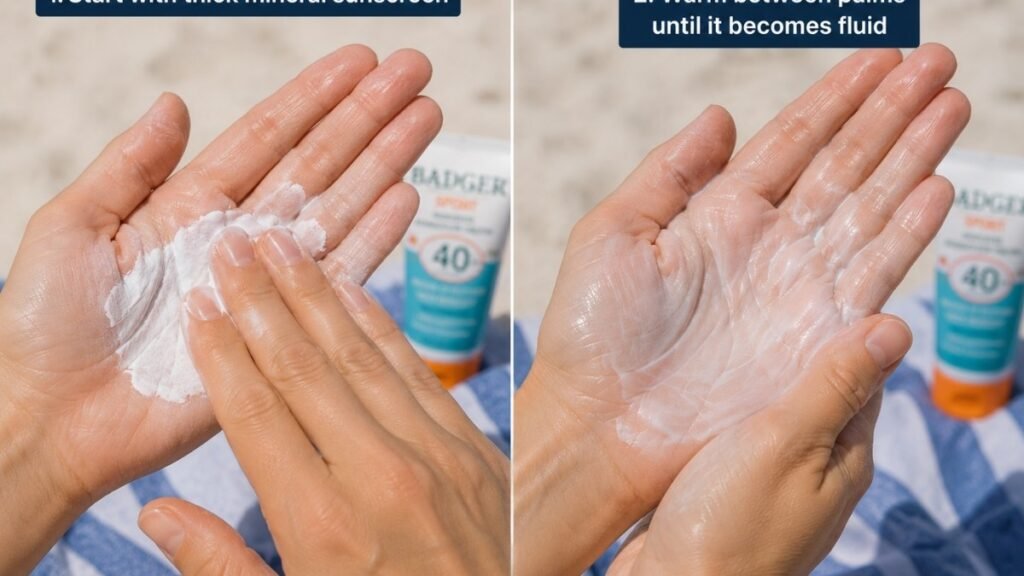
The technique that helps everything: Squeeze sunscreen into your palm, rub palms together to warm it, then apply. Cold mineral sunscreen straight from the tube is always harder to work with.
Best for Active Kids
Winner: Raw Elements Eco Formula — designed for serious water activity. The 23% zinc oxide concentration combined with the HEL water resistance certification makes it the right formula for children who are in and out of the water all day.
Runner-up: Badger Sport — the four-ingredient formula is active-use appropriate and the sport label reflects genuine 80-minute water resistance testing.
Best After Swimming
Reapplication after swimming requires a formula that goes on reasonably quickly without a production. The Babo Botanicals Sheer is the best format for post-swim reapplication on children — it distributes faster, covers more area per pump, and goes on over slightly damp skin better than thicker formulas.
Florida Gulf Coast and Caribbean Sunscreen Rules Every Family Should Know
If you’re visiting Florida with children, the practical sunscreen knowledge is slightly different from what you’d need for a backyard pool.
Florida state law: Florida has not enacted a statewide sunscreen ban equivalent to Hawaii’s. There is no state law prohibiting oxybenzone or octinoxate in Florida at the time of writing.
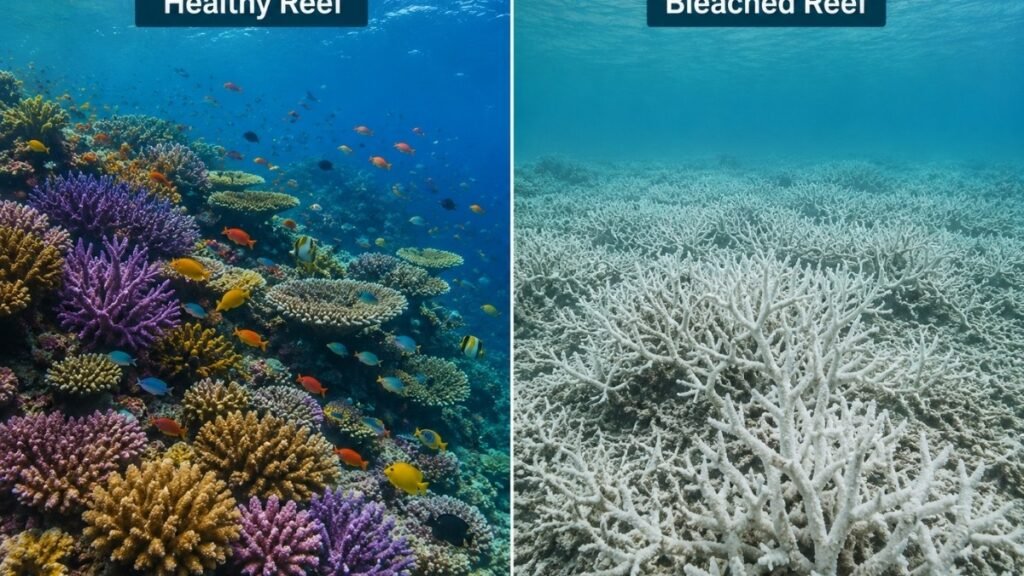
However — the destinations matter. Florida Keys National Marine Sanctuary includes some of the most fragile reef systems in North America. Key Largo, Key West, and the Florida reef tract are biologically connected environments where sunscreen pollution is a genuine and documented concern. The Florida Keys reef system has lost approximately 90% of its coral cover since the 1970s — a collapse driven by multiple factors including warming, runoff, and chemical contamination. No one factor, including sunscreen, is solely responsible, but the reef’s current fragility means every source of additional stress matters.
Turks and Caicos: Requires reef-safe sunscreen when entering the water. Chemical sunscreens are prohibited in the water at snorkeling and diving sites. Bring mineral sunscreen before you arrive — availability in TCI is improving but inconsistent, and prices are significantly higher than US retail.
Costa Rica national parks: Reef-safe sunscreen is required when entering the water in national park boundaries, including Manuel Antonio. Bring non-nano zinc oxide from home.
Hawaii: Oxybenzone and octinoxate are banned from sale. Retailers cannot sell sunscreens containing these ingredients. If you’re connecting through Honolulu, the airport retailers will only carry compliant products — but bring your tested family formula from home rather than relying on airport retail prices.
The practical Gulf Coast answer: For Clearwater Beach, Siesta Key, Destin, and the main Florida Gulf Coast destinations, there’s no legal requirement. But families snorkeling at Siesta Key’s Point of Rocks, Panama City Beach’s St. Andrews jetty, or Caladesi Island are swimming near active marine environments. Reef-safe sunscreen is the right choice here regardless of legal requirements.
How to Apply Mineral Sunscreen Without the White Cast
The white cast problem is real — but it’s almost entirely a technique problem, not an ingredient problem. Here’s what actually works.
Apply in Dots, Not Stripes
Squeeze sunscreen onto your palm, distribute it in dots across the application area (cheeks, forehead, nose, chin for a face), then blend outward from each dot. This gives you even distribution from the start rather than trying to spread a thick central stripe.
Warm It in Your Hands
This is the single most impactful technique change. Squeeze the sunscreen into your palm, rub your hands together for 5–10 seconds to warm the formula to skin temperature. Mineral sunscreen that’s been warmed distributes noticeably faster and more evenly than cold sunscreen applied directly. The difference is immediate.
Moisturize First
A light layer of fragrance-free moisturizer applied before mineral sunscreen gives it a smoother surface to blend into. This is particularly useful for faces — children’s skin is often dry at the beach, and dry skin exaggerates white cast.
Don’t Wait Until You’re on the Beach
Apply mineral sunscreen 30 minutes before sun exposure, while you’re still at the rental or hotel. This gives the formula time to settle and allows any initial white cast to blend in before you’re standing in the sun trying to wrangle an impatient child while also managing a cooler, chairs, and a toddler.
How to Remove Mineral Sunscreen After a Beach Day
Mineral sunscreen requires slightly more removal effort than chemical formulas because the zinc oxide doesn’t dissolve in water alone.
5-minute family cleanup routine:
- Rinse with warm water in the shower to remove salt and sand
- Apply a coin-sized amount of gentle cleansing oil or micellar water to dry or slightly damp skin — this dissolves the zinc oxide
- Work in circular motions for 30 seconds, then rinse
- Follow with your regular gentle cleanser for children
- For faces specifically, a cleansing balm or micellar water on a cotton pad removes residue more completely than water alone
This routine takes five minutes once everyone’s in the shower at the end of the day and means children go to bed with clean, not zinc-coated, skin.
Build a Reef-Safe Sun Protection Kit
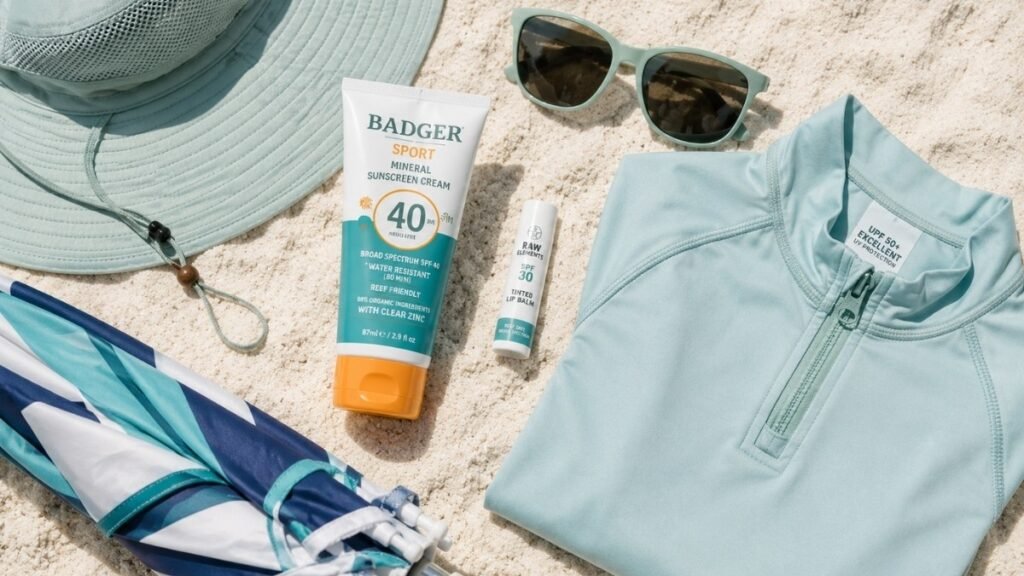
Sunscreen is part of a complete sun protection system, not a standalone solution. The most effective sun protection on a beach day combines multiple layers — and reduces the total sunscreen volume you need to apply and reapply, which is genuinely useful with children who resist the process.
UPF 50+ Rash Guards — Cover the torso and arms through hours of water time. A child in a rash guard needs sunscreen only on face, neck, and any exposed areas. This cuts application time in half and reduces the volume of sunscreen used significantly.
Wide-Brim Sun Hat — A 3-inch or wider brim provides meaningful face and neck shade. The style children will actually keep on their head is the one you should buy, even if it’s not the most protective option in the store.
Beach Umbrella or Shade Structure — For young children who need extended shade time, a UPF-rated umbrella or canopy provides protection during the hours when UV is most intense (10 AM – 4 PM). We cover the best options in our beach umbrella guide and beach tent guide.
UV-Blocking Sunglasses — For adults and older children. Polarized lenses reduce glare from water surfaces, and UV-blocking lenses protect against cumulative eye exposure that contributes to cataracts over time.
SPF Lip Balm — The most consistently forgotten sun protection item. Lips burn at the beach. Apply SPF lip balm before you leave the house and carry it for reapplication.
Before You Buy: Our Quick Checklist
Use this before purchasing any sunscreen labeled “reef safe”:
✅ Active ingredient is non-nano zinc oxide or titanium dioxide — this is the only check that matters
✅ Fragrance-free — especially important for children with sensitive skin
✅ Water resistant 80 minutes — the maximum FDA-allowed claim; anything less isn’t right for beach use
✅ SPF 50+ for children and fair skin; SPF 30+ minimum for everyone
✅ Approved for reef destinations — if visiting Hawaii, Turks and Caicos, Costa Rica national parks, or similar, verify no banned ingredients
✅ Size appropriate — plan one 8 oz bottle per person per week of beach time when applying correctly
✅ No added nano-particles — if zinc oxide is the active ingredient, confirm “non-nano” is specified
Frequently Asked Questions
Is reef-safe sunscreen really better for kids? Yes, for two independent reasons. First, mineral sunscreens with non-nano zinc oxide avoid the systemic absorption concerns associated with chemical UV filters — particularly relevant for children whose skin is more permeable than adults’. Second, reef-safe sunscreen protects the marine environments that make beach destinations worth visiting. The same coral reefs that families snorkel on are the ones damaged by chemical sunscreen ingredients.
Is “reef friendly” the same as reef safe? Neither term is regulated, so technically both mean whatever the brand decides they mean. The practical check is identical: look for non-nano zinc oxide or titanium dioxide as the only active ingredients. The label language is irrelevant compared to the ingredient panel.
Why do mineral sunscreens leave a white cast? Zinc oxide is a white powder by nature — when applied to skin, it remains visible until blended in. The white cast is most pronounced on deeper skin tones and in formulas with higher zinc oxide concentrations (above 20%). Sheer formulations (like Babo Botanicals), tinted options (like Badger Tinted), and titanium dioxide blends reduce visible cast. Warming the formula before application reduces it further.
Can babies wear reef-safe sunscreen? The AAP recommends avoiding sunscreen on babies under 6 months — shade, protective clothing, and hat are the recommended protection methods for this age. For babies 6 months and older, non-nano zinc oxide mineral sunscreen is appropriate. Thinkbaby and Badger Baby are the most commonly recommended formulas for infant use.
Does Florida require reef-safe sunscreen? Florida does not have a statewide reef-safe sunscreen requirement. Individual destinations — particularly in the Florida Keys — may encourage reef-safe sunscreen use. Families snorkeling near Florida reef systems should use non-nano zinc oxide sunscreen regardless of legal requirements, given the documented fragility of Florida’s remaining coral.
Are spray reef-safe sunscreens a good idea? Mineral sunscreen sprays exist, but they have two practical limitations: spray application provides significantly less consistent coverage than lotion, and mineral sunscreen aerosols should not be inhaled. If you use a mineral spray, spray it onto your hands and rub it in — which essentially converts it to a messy lotion application. For children, lotion or stick formats are more reliable.
How often should I reapply reef-safe sunscreen at the beach? Every two hours minimum, and immediately after swimming or toweling off — regardless of water resistance rating. A sunscreen rated for 80 minutes of water resistance has been tested under laboratory conditions; real beach use (children rubbing their faces on towels, sweating, and then jumping back in the water) reduces effective duration. When in doubt, reapply.
What’s the difference between non-nano zinc oxide and titanium dioxide? Both are mineral UV filters approved as reef-safe. Non-nano zinc oxide provides slightly broader UVA coverage and is considered the more comprehensive protector of the two. Titanium dioxide provides slightly less white cast and is a good option for anyone extremely concerned about the cast issue. Most premium reef-safe formulas use a combination of both for balanced coverage and texture.

Final Thoughts
Protecting coral reefs matters — genuinely — and the connection between the sunscreen your family wears and the health of the reef you’re snorkeling above is real and documented. That’s worth caring about.
But for most parents standing in the sunscreen aisle, the more pressing question is simpler: which one will I actually put on my kids, twice a day, for a week at the beach?
The best reef-safe sunscreen for your family is not necessarily the one with the most impressive certification. It’s the one that goes on easily enough that you’ll apply the right amount, that doesn’t cause your child to spend the afternoon looking like they lost a fight with a tub of white paint, and that you’ll actually remember to reapply when the two-hour timer goes off.
Badger Sport or Babo Botanicals Sheer for most families. Thinkbaby for babies. Blue Lizard Face Stick for face application on resistant children. Hello Bello if budget is the main consideration.
Check the active ingredients panel. Choose non-nano zinc oxide. Apply 30 minutes before you hit the sand. Reapply at two hours.
The reef will thank you. So will your kids’ skin.
Planning your beach gear setup? Read next:
- What to Bring to the Beach: Complete Beach Gear Guide
- Best Beach Umbrella: What Actually Holds Up in Wind
- Best Beach Tent: Top Picks for Families
- Beach Vacation Packing Checklist: What Families Actually Need
- Turks and Caicos Snorkeling: The Honest Family Guide
- Costa Rica Beaches: The Honest Family Guide
At Exproly, we judge beach gear by one simple question: Would we happily pack it again for our own family trip?