
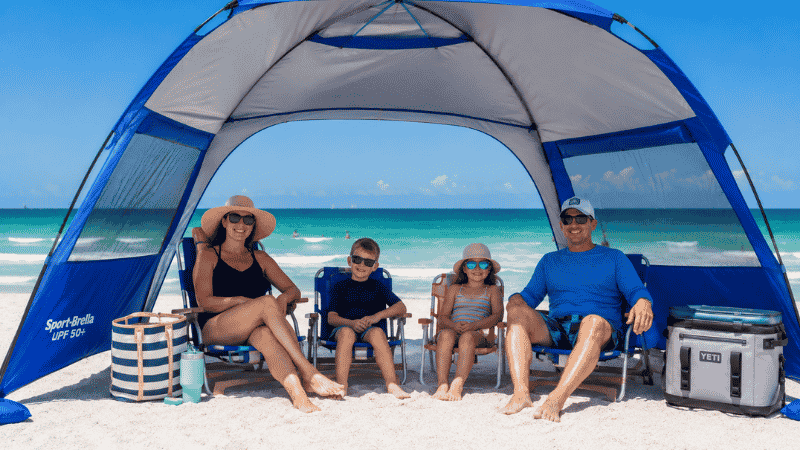
Here’s a scene that plays out on Florida beaches every summer Saturday: someone shows up with a traditional beach umbrella, wrestles it into the sand, gets it roughly upright, sits down — and then spends the next three hours repositioning it every 20 minutes as the sun moves and the shade chases them like some demented game of tag. By 2 PM the pole has worked loose twice, the canopy has inverted once, and the “shade” is a triangle barely large enough for one person’s legs.
There is a better solution. It’s called a beach tent, a beach shade, or a beach canopy — and it provides consistent, full-body protection from the sun over a large area, stays put in coastal wind when properly anchored, and doesn’t require you to chase it around the beach all day.
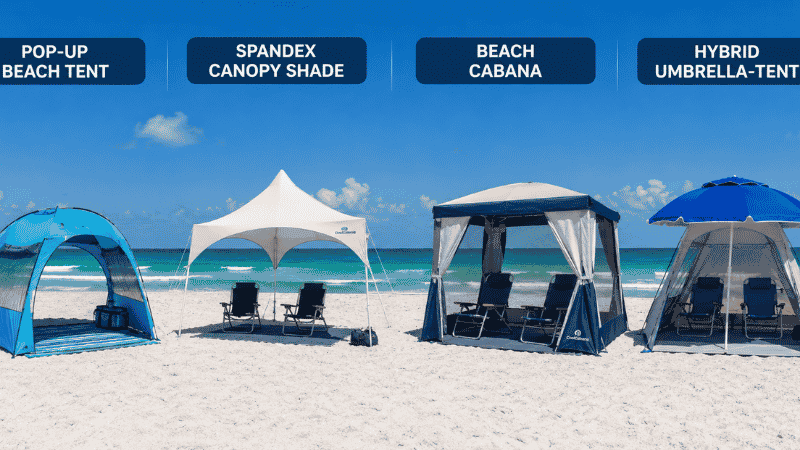
The challenge is that the beach tent market is genuinely confusing. There are four distinct types — pop-up tents, spandex canopies, cabanas, and hybrid umbrella-tents — and they suit completely different beach conditions and use cases. Buying the wrong type for your specific beach is the most common mistake, and it’s entirely avoidable with the right information.
This guide covers everything: the four types explained honestly, the five features that separate good beach tents from useless ones, and clear recommendations by use case — so you can pick the right shelter for your beach, your group size, and the Florida Gulf Coast conditions you’re actually going to encounter.
Key Takeaways
- There are four distinct beach tent types — pop-up, spandex canopy, cabana, and hybrid — and they suit different conditions; buying the wrong type is more common than buying a bad product
- Wirecutter’s top picks are the Sun Ninja Tent 4 Person (best for variable wind) and the Shibumi Shade Classic (best for steady coastal wind) — both outperform traditional umbrellas significantly for families
- UPF 50+ is non-negotiable — unrated or UPF 30 fabric on a beach tent provides inadequate UV protection for Florida summer conditions where UV index regularly hits 10–11
- A silver-lined canopy reduces interior temperature by up to 10°F compared to direct sun — meaningful on a Florida Gulf Coast afternoon
- Some Florida and East Coast beaches ban large canopies and tents — check local beach regulations before purchasing a large footprint shelter
The Four Types of Beach Tent — Which One Is Right for You
Most buying guides skip this step and go straight to product recommendations. That’s why people end up with a Shibumi Shade on a windless day or a pop-up tent on a narrow crowded beach. Understanding the types first saves you from the wrong purchase entirely.
Type 1: Pop-Up Beach Tents — The Most Versatile All-Rounder
Pop-up beach tents have a pre-assembled spring frame that expands automatically when you release it from its carry bag. Setup typically takes under 60 seconds for one person. They’re three-sided (open front, two closed sides, closed back), which provides the most sun protection of any beach shelter type — covering you from above and from multiple lateral angles as the sun moves through the day.
Best for: Families with young children, anyone who wants maximum UV protection, beach visitors who want privacy for changing or diaper changes, full beach days of 5+ hours in Florida summer heat.
Trade-offs: The largest footprint per person of any shelter type. Some crowded beaches have banned large pop-up tents. Folding them back down takes practice — the first time is always a small battle.
Florida Gulf Coast verdict: The right choice for Siesta Key, Clearwater, or Destin family beach days where you’re setting up a home base for the day. The three-sided design handles the afternoon lateral sun that traditional umbrellas completely miss.
Type 2: Spandex Canopy Shelters — Best for Large Groups in Steady Wind
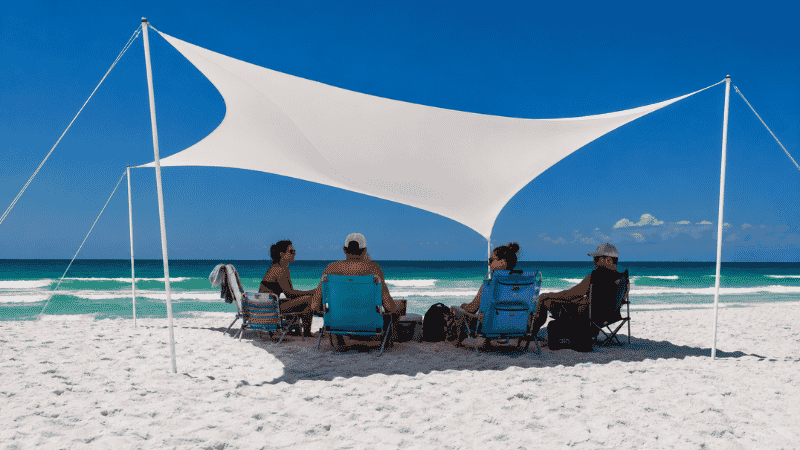
The Shibumi Shade is the category-defining product here. A spandex or stretch-fabric canopy is supported by poles or arms at the corners rather than a central frame. It provides shade from above (not from the sides), setup is simple in 2–3 minutes, and the open-sided design allows maximum airflow — which matters significantly in Florida summer heat.
Best for: Groups of 4–8 people, beaches with consistent onshore wind (the Shibumi literally uses wind to stay taut), anyone who values airflow over enclosed privacy.
Trade-offs: Requires wind to stay taut and provide proper shade — in still air, the canopy droops. Large footprint that extends significantly beyond the shaded area. Wirecutter specifically notes that some beaches have banned this style. Not ideal for variable wind conditions where the poles can shift.
Florida Gulf Coast verdict: Works beautifully on Panhandle beaches (Destin, Panama City Beach) where reliable afternoon sea breezes are the norm. Less ideal on calmer Gulf days when the air is still and the canopy sags.
Type 3: Beach Cabanas — Best Wind Resistance, Smallest Footprint
A beach cabana is a tall, open-sided shelter supported by a central pole and four corner legs. Unlike a pop-up tent, all sides are open — you walk directly in and out without ducking. The open design allows wind to flow through rather than pushing against the shelter, which makes cabanas the most stable option in genuinely windy conditions.
Best for: Windy beaches, solo travelers or couples who want a standing-height shelter, anyone who finds enclosed tents claustrophobic.
Trade-offs: No side protection from lateral sun. Less privacy than enclosed pop-up tents. Typically taller and bulkier to pack than other options.
Florida Gulf Coast verdict: Excellent for Atlantic-facing beaches (Cocoa Beach, St. Augustine) where wave-driven wind is more consistent. Also works well on Panhandle beaches in afternoon wind.
Type 4: Hybrid Umbrella-Tents — Best for Traditional Beach Rules
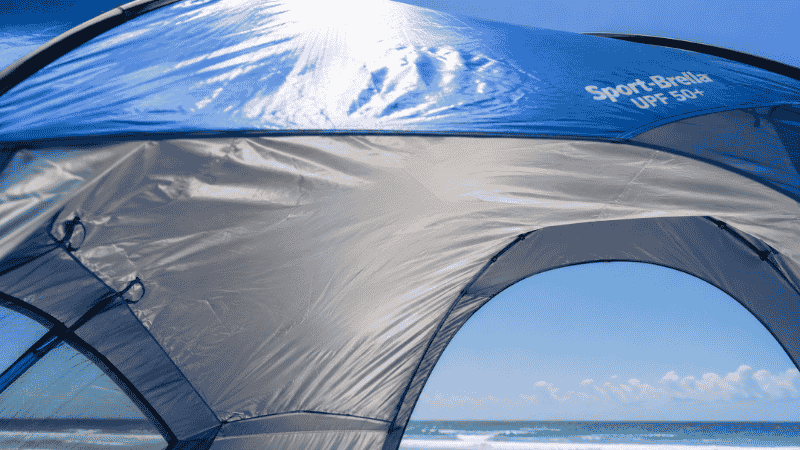
Products like the Sport-Brella Premiere XL use a central pole (like an umbrella) but add tent flaps that extend down the sides for lateral sun and wind protection. They look more like a traditional umbrella than a tent, which matters on beaches with strict shade restrictions.
Best for: Beaches with canopy/tent bans that still allow traditional umbrellas, anyone who wants more protection than a standard umbrella without a full tent setup.
Trade-offs: More complex setup than a pop-up. Wind performance is better than a standard umbrella but worse than a dedicated tent or cabana.
Florida Gulf Coast verdict: The right compromise if you’re visiting a beach with shade restrictions or if you’re undecided between umbrella and tent and want both-ish.
The 5 Features That Separate Good Beach Tents From Bad Ones
1. UPF Rating — The Non-Negotiable
UPF 50+ blocks over 98% of UV radiation. On a Florida Gulf Coast beach in July, where the UV index regularly hits 10–11 (Extreme), UPF 50+ fabric is not a premium feature — it’s the baseline you should require for any beach shelter.
A silver-lined canopy underside adds heat reflection to UV blocking. Multiple tested beach tents show interior temperature differences of up to 10°F compared to direct sun. In Florida summer conditions, the difference between a silver-lined UPF 50+ shelter and a basic one is the difference between a comfortable afternoon and heat exhaustion.
Do not purchase any beach tent without a verified UPF 50+ rating. “UV protection” without a UPF number is marketing language, not a specification.
2. Anchoring System — How It Stays Put
Sandbags are the most effective anchoring system for beach tents. Built-in sandbag pockets at each corner leg or arm allow you to fill them with sand on-site and let gravity do the work. A properly filled sandbag system is more secure than stakes alone in loose dry sand.
Stakes and guy lines supplement sandbags in windier conditions. Better beach tents include both — stakes for the corners and guy lines that extend further out to distribute wind load.
What to avoid: Tent designs that rely solely on stakes in loose Florida beach sand. The quartz sand on Gulf Coast beaches doesn’t pack as firmly as Atlantic sand, and stake-only systems pull loose more easily.
3. Ventilation — Airflow Is Not Optional
A beach tent without ventilation becomes a heat trap in Florida summer conditions. Mesh windows on the back and sides allow cross-ventilation, which is what separates a comfortable shelter from one you abandon by noon.
Look for at least two mesh windows on opposite sides of the tent — this creates actual cross-breeze rather than just an opening. A ventilated back panel (mesh rather than solid fabric) is even better.
4. Size Calibration — Manufacturer Claims vs. Reality
Beach tent size claims from manufacturers consistently overstate comfortable capacity. A tent labeled “4 person” comfortably fits 2–3 people with beach chairs. A “6 person” tent is a realistic family-of-four shelter with gear.
Rule of thumb: If you need to fit beach chairs inside the tent (which you will in Florida summer heat), choose a tent sized for one more person than your actual group.
Practical dimensions: A comfortable family setup for 2 adults and 2 children needs at least 7×5 feet of interior floor space. Check actual dimensions, not capacity claims.
5. Pack Size and Weight — The Reality of Getting It to the Beach
A beach tent that’s too heavy or too large to carry practically from the parking lot doesn’t get used. The best family beach tents weigh 4–7 lbs and pack to a carry bag under 30 inches long — manageable in one arm while carrying a cooler in the other, or attachable to a beach wagon.
Above 10 lbs, you need a beach wagon. That’s not necessarily a dealbreaker, but it’s a real logistical consideration for beach access points with long walks through soft sand.
Best Beach Tent by Use Case
Best for Families (Wirecutter Top Pick): Sun Ninja Tent 4 Person
Wirecutter named the Sun Ninja Tent 4 Person their top pick for versatile weather conditions after testing seven beach shelters. The stretch spandex canopy sets up in under 3 minutes, provides shade for 4 people lying down, and tolerates variable wind conditions up to approximately 15 mph without failing. The sand-filled corner pouches anchor it effectively without stakes.
What it does well: Fast setup, spacious shade, good wind tolerance for Gulf Coast afternoon breezes, genuinely easy to move if you need to reposition.
Honest trade-off: The footprint extends well beyond the shaded area — the four corner arms stretch out several feet in each direction. On a crowded beach, this can be an issue. In very strong gusts, the poles can shift and the tent can collapse temporarily (it won’t become a projectile — it just loses its shape until repositioned).
Who it’s for: Families setting up a home base for the day on Gulf Coast beaches with moderate afternoon wind. Siesta Key, Clearwater Beach, Destin.
Best for Steady Coastal Wind: Shibumi Shade Classic
The Shibumi Shade is an engineering-based beach shade that uses wind to stay taut rather than fighting it. A single pole creates an arch, the spandex canopy stretches between the pole and four corner sandbags, and as long as there’s a steady onshore breeze, the canopy floats above you providing shade for up to 8 people in the Classic size.
Wirecutter names it the best beach shade for steady wind. Outside Magazine and multiple outdoor gear publications have named it a top pick. The product has a 4.9-star rating from over 3,600 reviews on the manufacturer’s own site.
What it does well: Minimal weight (4 lbs), compact pack size, exceptional shade coverage for groups, near-zero wind resistance when properly tensioned.
Honest trade-offs: Requires steady wind to stay taut — in still air or variable gusts, the canopy droops and shade quality drops significantly. Some Florida and East Coast beaches have banned canopies of this style and size. Check your specific beach regulations before purchasing. The 2026 version includes the Wind Assist kit (sandbags and guylines) bundled at no extra charge, which addresses the no-wind and variable-wind performance significantly.
Who it’s for: Groups of 4–8 on beaches with consistent onshore breeze. Florida Panhandle beaches (Destin, Panama City Beach, 30A corridor) where afternoon sea breezes are reliable. Not the right choice for calmer Gulf Coast spots on still days.
Best Pop-Up Tent for Families: G4Free or Gorich Style (UPF 50+ with Silver Lining)
For families who want a traditional pop-up tent rather than a spandex canopy style, look for these non-negotiable specs: UPF 50+ rated fabric with silver lining, at least two mesh ventilation windows, built-in sandbag pockets plus stake loops, pop-up frame that one person can deploy in under 60 seconds, and packed weight under 7 lbs.
Multiple products in the $60–$100 range meet this spec. The differences between them are primarily in interior space and sandbag system quality. Read actual dimensions rather than person capacity claims.
Who it’s for: Families with young children, anyone who wants the most UV protection, beach days where shade is the primary need rather than group socializing.
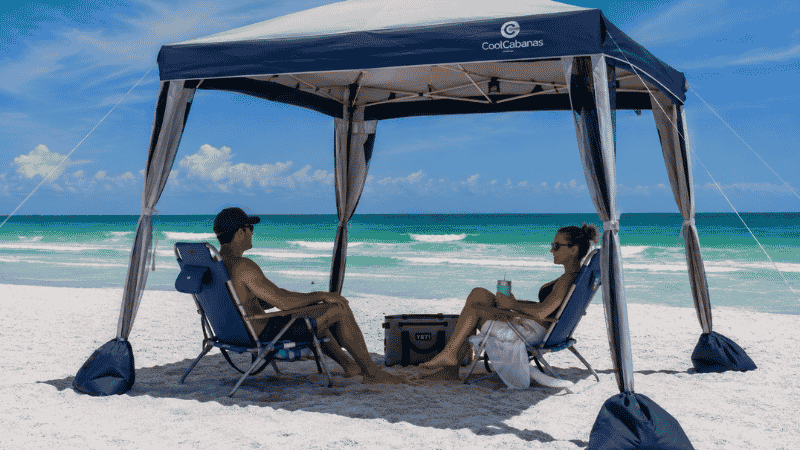
Best Cabana for Wind Resistance: Qipi Beach Cabana
CNN Underscored tested multiple beach shelters and named the Qipi Beach Cabana one of the most wind-resistant options in their testing — the open-sided design allows wind to pass through rather than push against it, and the four-leg sandbag system holds well in coastal conditions.
The cabana’s standing-height design means you can walk in and out easily, and the open sides provide continuous airflow that makes it noticeably more comfortable in high-heat Florida summer conditions than an enclosed pop-up tent.
Who it’s for: Solo travelers, couples, or small groups who want a standing-height shelter with maximum airflow. Windy beaches where tent instability is a consistent problem.
Best Budget Option: Under $60 with UPF 50+
In the sub-$60 range, the most important thing is verifying UPF 50+ certification — not just “UV protection” language. Several products in this range (AMMSUN, Blissun, and similar) provide adequate shade for occasional beach visitors who aren’t spending full days in peak Florida summer heat.
Honest expectation: budget beach tents in the $30–$50 range will have lighter pole materials, simpler anchoring systems, and less durable carry bags. They work in calm to moderate conditions for occasional use. If you’re going to Florida beaches regularly, the $80–$120 range is worth the investment.
Beach Tent Regulations — Check Before You Buy
This is the most important practical note in this entire guide.
Multiple Florida counties and beaches have implemented regulations on beach shelters, particularly large canopy-style tents. Some beaches limit shelter size (no more than a certain square footage). Some ban tent-style shelters entirely, allowing only traditional single-pole umbrellas. Some have time restrictions on when shelters can be set up.
Beaches with known restrictions (check current regulations before visiting):
- Clearwater Beach — size and setup restrictions apply
- Some Pinellas County beaches — check current ordinances
- Various New Jersey and New York beaches — Shibumi-style canopies specifically banned on some beaches
What to do: Check the official website or call the parks department for any beach you’re visiting before purchasing a large tent or canopy. A $120 Shibumi Shade that’s banned at your specific beach is not a useful purchase.
How to Set Up a Beach Tent Correctly
Pop-Up Tents
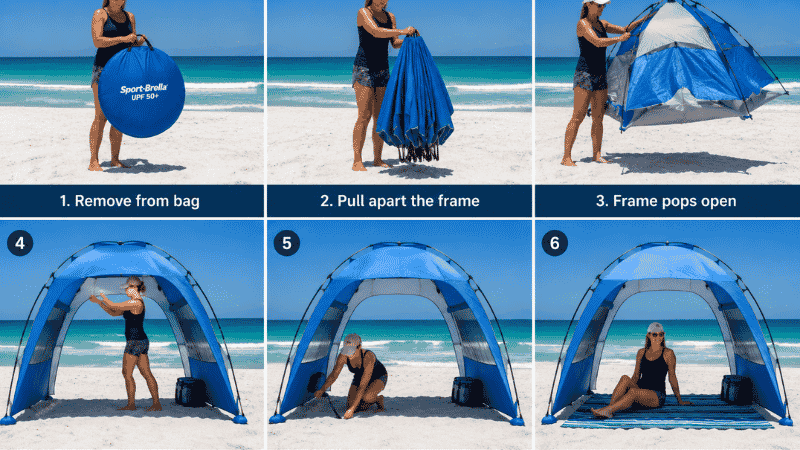
- Remove from carry bag and release the spring frame — it opens automatically
- Position with the closed back facing the wind direction
- Fill sandbag pockets completely with sand (not halfway)
- Stake the corners and run guy lines if included
- Position mesh windows upwind for cross-ventilation
The fold-back-down problem: Pop-up tents notoriously resist going back in the bag the first time. Practice at home before your beach trip. The technique involves folding in figure-eight motions, not trying to compress it straight down.
Spandex Canopy (Shibumi Style)
- Identify wind direction
- Lay canopy flat, oriented so wind will blow through the open front
- Fill corner pouches/sandbags on the downwind end
- Place pole to create arch on the upwind end
- Stretch canopy over pole and position for optimal tension
- Fill remaining corner pouches
No wind situation: Use the Wind Assist kit (included in 2026 models) or add sandbag weight to the corners and use guylines to create tension manually.
Beach Cabanas
- Position central pole
- Extend four legs at corners
- Fill sandbag bases at each leg
- Angle open sides away from direct wind if possible
If You Only Have 10 Minutes to Choose
Three questions to answer:
1. Do you have steady coastal wind at your beach? Yes → Consider Shibumi Shade Classic. No or variable → Pop-up tent or cabana.
2. How many people and how many hours? 1–3 people, 2–4 hours → Lighter pop-up or cabana, $50–$80 range. 4+ people, full day → Sun Ninja Tent or large pop-up, $80–$120 range.
3. Are you visiting a beach with shelter restrictions? Check first. If yes → Hybrid umbrella-tent (Sport-Brella style) or standard umbrella.
Frequently Asked Questions
What is the best beach tent for families? The Sun Ninja Tent 4 Person (Wirecutter’s top pick for versatile weather) or a UPF 50+ pop-up tent with silver lining and sandbag anchoring. For families with young children, the three-sided pop-up design provides the most complete UV protection. For groups of 4–8 on windy Panhandle beaches, the Shibumi Shade Classic offers exceptional coverage.
What is the difference between a beach tent and a beach canopy? A beach tent is typically three-sided with a closed back and sides, providing more enclosed protection. A beach canopy is open on multiple sides (sometimes all sides) and focuses on overhead shade with more airflow. Cabanas are a type of canopy with a central pole design. The right choice depends on your UV protection needs vs. airflow preference.
Are beach tents allowed on Florida beaches? It varies by beach and county. Many Florida beaches allow beach tents and shelters; some have size restrictions or ban specific styles. Check the regulations for your specific destination before purchasing — particularly if you’re considering a large canopy-style shelter like the Shibumi Shade.
What size beach tent do I need? For 2 adults and 2 children with beach chairs: look for a tent with at least 7×5 feet of interior space, typically marketed as a “4–6 person” tent. Manufacturer capacity claims assume people lying flat without chairs — size up from what you think you need.
How do I keep a beach tent from blowing away? Fill sandbag pockets completely (not halfway) — this is the most common setup error. Add stakes at all corners. Run guy lines if included. On very windy days, position the open side or ventilation side facing the wind so it passes through rather than catching the structure.
What is a Shibumi Shade and is it worth it? The Shibumi Shade is a wind-powered spandex canopy that uses coastal wind to stay taut rather than a rigid frame. It’s worth it specifically for beaches with reliable onshore breeze (Florida Panhandle, Cape Cod, Outer Banks) and groups of 4–8 people. It’s not ideal for calmer Gulf Coast spots on still days or beaches with canopy size restrictions.
How do I fold a pop-up beach tent back down? The figure-eight fold: grab opposite sides of the frame and twist one end forward and one end back simultaneously until the tent collapses into three overlapping circles, then compress them together flat. Practice at home before your first beach trip.
The Bottom Line
A traditional beach umbrella makes sense for one or two people doing a short beach visit. For anyone else — families, groups, people spending full days on Florida beaches in summer heat — a beach tent or shade shelter is a meaningfully better experience.
The right choice comes down to two things: your beach’s wind conditions and your group’s size. Consistent coastal wind on a Panhandle beach with 6 people → Shibumi Shade Classic. Variable Gulf Coast conditions with a family of four → Sun Ninja Tent or solid pop-up with UPF 50+ silver lining. Windy exposed beach with maximum stability priority → beach cabana.
Check your beach’s shelter regulations before you buy. Set up your sandbags properly when you get there. And enjoy the afternoon without chasing a patch of shade around the sand.
Getting ready for your Florida beach trip? Read next:
- Best Beach Umbrella 2026: What to Buy and What Actually Works
- Beach Vacation Packing List: What to Actually Bring
- Best Beaches in Florida: The Realist’s Guide to Choosing the Right Shore
- Things to Do at the Beach: 30 Ideas Beyond Lying on the Sand
References
- Wirecutter (NYT) — Best Beach Umbrellas and Shades: tested recommendations 2025–2026
- CNN Underscored — Best Beach Tents: tested 2026
- American Society for Testing and Materials — ASTM F3681-24 Beach Umbrella and Shelter Wind Safety Standard
- American Cancer Society — UV Radiation and Sun Protection: cancer.org
- Skin Cancer Foundation — UPF Fabric Standards: skincancer.org
- Reviewed.com — Best Beach Umbrellas, Shades and Tents 2026