
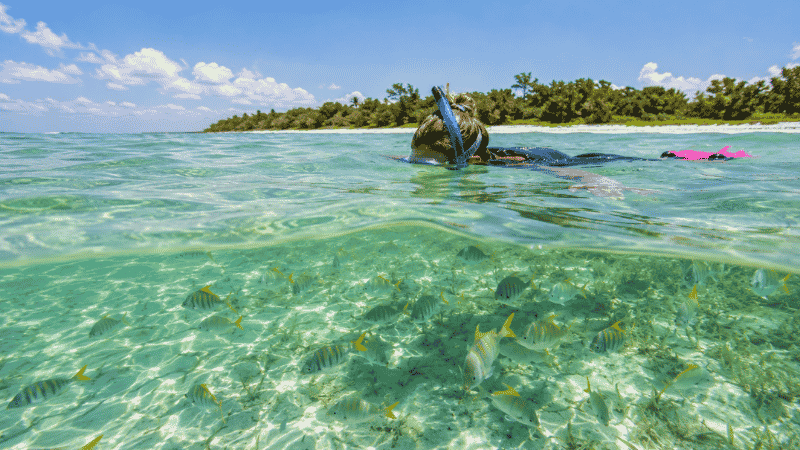
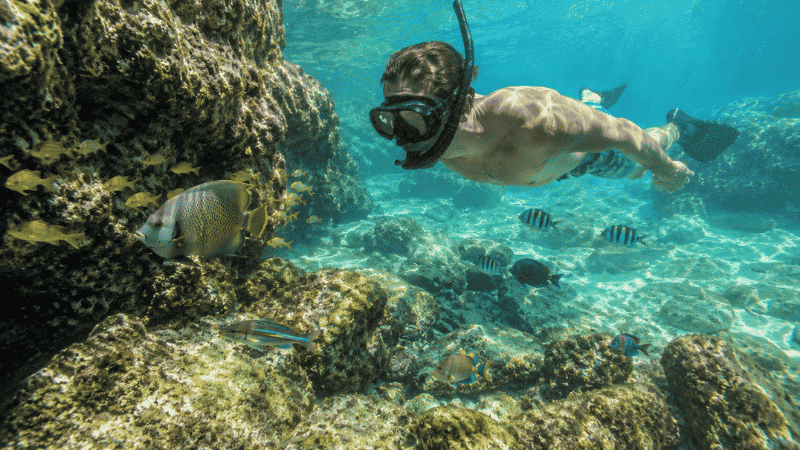
The first time you put your face in the ocean with a mask and snorkel, something shifts. You’re looking at the same water you’ve been swimming in all week — and suddenly it’s a completely different world. Fish moving through the seagrass, light rippling across the sandy bottom, the muffled quiet of being just below the surface. It takes about 45 seconds to understand why people do this for the rest of their lives.
But that first experience can also go badly wrong if you’re not prepared. A mask that fogs immediately. Water flooding the snorkel tube. The slightly panicked feeling of trying to breathe through a tube while your face is in the ocean for the first time. These are all fixable problems — but they’re the kind of problems that ruin the experience for beginners who didn’t know they were coming.
Snorkeling is genuinely not difficult. Most people who say they couldn’t do it were using the wrong gear, had a mask that didn’t fit, or jumped in before they understood the three or four basic techniques that make everything work. This guide covers all of it — gear selection, technique, where to snorkel in Florida, how to manage kids, and how to tell a good snorkeling day from a dangerous one.
Key Takeaways
- Snorkeling vs scuba diving: Snorkeling requires zero certification and stays at the surface — you never need to hold your breath or descend; scuba diving involves tanks, training, and going deeper. Snorkeling is accessible to almost any swimmer
- Mask fit is everything — a mask that doesn’t seal to your face will flood immediately; test before you buy by pressing it to your face without the strap and inhaling through your nose (it should hold in place)
- The #1 beginner mistake is tensing up and trying to control breathing actively — shallow, relaxed breathing through the mouth is all that’s needed; fighting the snorkel makes it harder, not easier
- Best Florida snorkeling locations: Point of Rocks at Siesta Key, the jetty at St. Andrews State Park in Panama City Beach, and the reef snorkeling off Clearwater at Caladesi Island — all shore-accessible, no boat required
- Children as young as 5–6 can snorkel successfully in calm, shallow conditions with a properly fitted child mask and a snorkeling vest for buoyancy
Is Snorkeling Hard? The Honest Answer
No — but it has a learning curve of about 20 minutes that catches most beginners off guard.
The mechanics are genuinely simple: float face-down, breathe through the tube, use your fins to move. That’s it. But the first 15–20 minutes in the water involve your brain adjusting to several unfamiliar sensations simultaneously — breathing through a tube, having your face submerged, seeing the underwater world for the first time, and managing the buoyancy and movement of fins.
The people who find snorkeling frustrating or give up are almost always in that first 20-minute window before the learning curve resolves. Stay in shallow, calm water for the first session, give yourself time to get used to the sensation, and the whole experience flips from stressful to effortless.
The one thing that makes everything easier: Relax your face in the water. Not your body — your face. The instinct is to tense up when your face is submerged. Consciously releasing that tension changes how the mask feels, how breathing feels, and how the whole experience feels.
Snorkeling Gear for Beginners — What You Actually Need
The Mask — The Most Important Decision
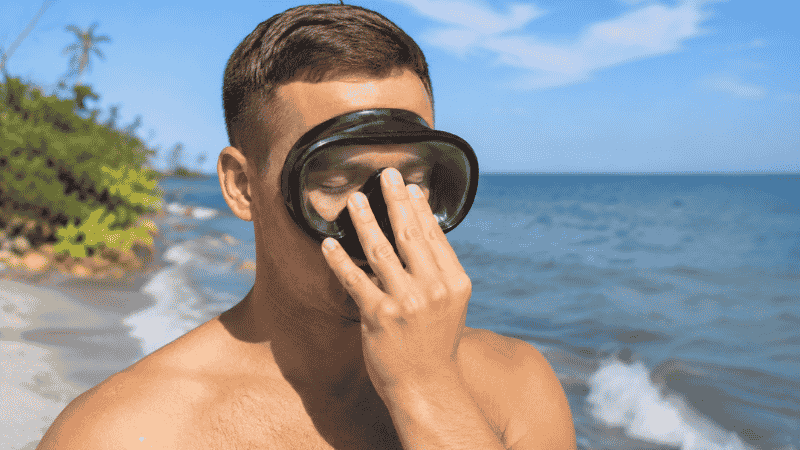
A mask that doesn’t fit your face will flood constantly and ruin the experience. This is not about brand or price — it’s about fit. Every face is shaped differently, and the mask needs to create a seal against your skin around the entire frame.
The fit test: Hold the mask against your face without the strap and inhale gently through your nose. A properly fitting mask will hold in place through suction alone. Release your inhale — if it drops away, it doesn’t fit your face shape. Try a different mask.
Silicone vs. plastic: The mask skirt — the part that contacts your face — should be soft silicone, not hard plastic. Silicone creates a better seal and is more comfortable for extended use. Almost all quality masks use silicone skirts; avoid the cheap plastic ones.
Full-face masks: Full-face snorkel masks (that cover your nose and mouth together) are marketed as beginner-friendly, but they have a poor safety record in strong currents and with inexperienced users. The American Journal of Emergency Medicine has documented multiple drowning incidents associated with full-face snorkel masks. Stick with a traditional mask and separate snorkel — it’s the proven design.
Prescription masks: If you wear glasses or contacts, prescription snorkel masks are available and worth the cost. Contacts can be worn snorkeling but carry infection risk from ocean water — a prescription mask eliminates this.
The Snorkel
A dry-top snorkel has a mechanism at the top that automatically seals when the tube is submerged, preventing water entry. For beginners this is a meaningful upgrade — you can dip your face underwater without the tube flooding, and if a wave washes over you, water doesn’t come flooding in.
The purge valve at the bottom allows you to clear any water that does enter with a forceful exhale rather than having to surface.
Standard vs. dry-top: A standard J-curve snorkel is cheaper and works fine in calm conditions. A dry-top snorkel costs $20–$40 more and is worth it for beginners who are still learning to manage the tube and the water.
Mouthpiece: The mouthpiece should feel comfortable in your mouth without significant jaw tension. If you’re biting down hard to hold it in place, the mouthpiece is too large for your jaw.
Fins
Fins allow you to move through the water using only your legs, leaving your hands free and significantly reducing the energy required to swim. For snorkeling at the surface, you don’t need power — you need easy propulsion.
Open-heel vs. full-foot: Full-foot fins (like a shoe — they enclose the foot entirely) are simpler for snorkeling and fine for the warm Florida Gulf water. Open-heel fins require boots and are better for cooler water or more active diving.
Fit: Fins should fit snugly without pinching. Too loose and they’ll come off; too tight and they’ll cause blisters. Try them on with the socks or boots you plan to wear.
Short-blade vs. long-blade: Long-blade fins require more power and are better for free diving. Shorter blades are more appropriate for relaxed surface snorkeling.
What You Don’t Need
You don’t need a wetsuit for Florida Gulf Coast snorkeling in summer (water is 80–85°F). A UPF rash guard is useful for sun protection on extended sessions. You don’t need an underwater camera on your first trip — focus on the experience, not documenting it. You don’t need a dive flag unless you’re swimming in areas with boat traffic.
How to Snorkel — Step by Step
Before You Get in the Water
Anti-fog your mask. New masks have a silicone coating from manufacturing that causes instant fogging. Remove it before the first use by scrubbing the inside of the lens with non-gel toothpaste, rinsing, and repeating several times. After that, the simplest anti-fog method before each snorkel session is to spit on the inside of the lens, rub the saliva around, and rinse briefly with seawater. Sounds unpleasant, works exceptionally well.
Rinse your gear before entry. Wet your mask, snorkel, and fins with seawater before putting them on. This reduces the temperature differential that causes fogging and helps the seal form properly.
Put your fins on at the water’s edge. Walking in fins on dry sand or a boat deck is a recipe for tripping. Wade in until the water is knee-deep, then put your fins on.
Getting Comfortable in the Water
Start in water that’s shallow enough to stand in — waist to chest depth. This gives you an escape hatch that takes the pressure off completely.
Put your face in the water and just breathe. Don’t try to swim yet. Focus entirely on the sensation of breathing through the tube. The breathing is slower than normal — inhale fully, exhale completely. The slight resistance of the tube is normal.
If your mask fogs: lift it off your face, dip it in the water to rinse, repeat the anti-fog process.
If water enters the snorkel tube: blow a sharp, forceful exhale through the tube. The air pressure clears the water through the purge valve or out the top. Two short sharp exhales work better than one long one.
If water enters the mask: don’t surface — press the top of the mask against your forehead to create a gap at the bottom, exhale firmly through your nose, and the water clears through the bottom seal. This takes practice but becomes instinctive quickly.
The Technique That Makes Everything Work
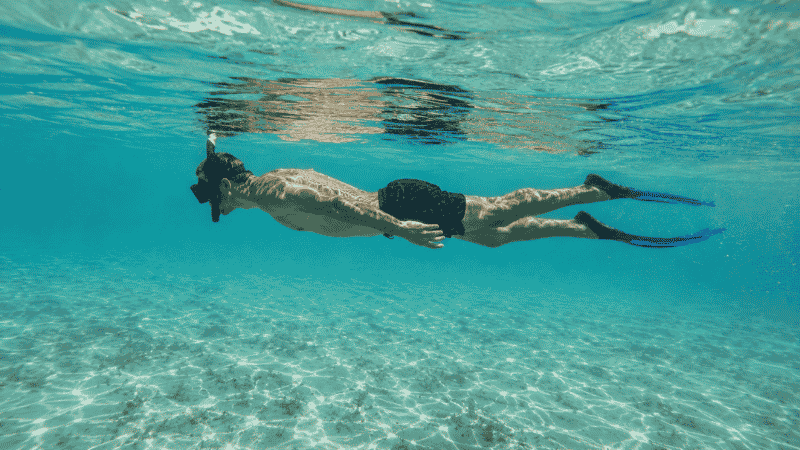
Float face-down, body horizontal, arms at your sides or extended forward. Your snorkel should be vertical — tilt your head slightly down so the tube clears the surface.
Move using only your fins. Long, slow, flutter kicks from the hip — not the knee. The ankle should be relaxed, not rigid. If you’re kicking hard and not moving much, your kicks are coming from the knee rather than the hip.
Your hands do nothing in calm-water snorkeling. Hands-at-sides is the default. Using your hands to swim while snorkeling wastes energy and creates turbulence that disturbs the fish you’re trying to see.
Look down, not forward. The instinct is to look ahead. The interesting things are below you. Keep your gaze down toward the bottom and let your peripheral vision manage navigation.
How to Breathe While Snorkeling
Slow, full breaths through the mouth. The exhale should be as complete as possible — letting stale air sit at the bottom of the tube reduces fresh air intake on the next breath.
The most common beginner mistake is breathing too quickly and shallowly, which leads to carbon dioxide buildup and a feeling of air hunger even when oxygen is plentiful. If you feel like you can’t get enough air, the fix is to slow down and exhale more completely — not to breathe faster.
If you feel anxious or panicked: stand up (if you’re in shallow water), remove the snorkel from your mouth, breathe normal air for a minute, and re-enter slowly. There’s no shame in taking a break, and a moment of reset is better than a bad experience that puts you off snorkeling permanently.
Snorkeling vs Scuba Diving — Which Is Right for You
Both involve underwater viewing. The differences matter for beginners deciding where to start.
Snorkeling: Stay at the surface. No training required. No certification. No equipment beyond mask, snorkel, and fins. Accessible to anyone who can swim. You see the upper layer of reef and marine life.
Scuba diving: Descend to depth. Requires certification (typically a 3–4 day open water course). Uses tanks and a breathing regulator. Allows access to deeper marine environments. Significant additional cost and equipment.
For a first underwater experience, snorkeling is the right starting point for almost everyone. Many dedicated scuba divers also snorkel regularly — the activities complement rather than replace each other.
If you find yourself wanting to go deeper and stay longer than surface snorkeling allows, that’s the natural signal that scuba diving might be the next step.
Best Snorkeling in Florida Gulf Coast — Shore-Accessible Options
You don’t need a boat to snorkel in Florida. These three spots are accessible from shore and consistently produce the best visibility and marine life on the Gulf Coast.
Point of Rocks — Siesta Key, Sarasota
Point of Rocks is a natural limestone formation at the south end of Crescent Beach on Siesta Key. It’s the best shore-accessible snorkeling spot on Florida’s Gulf Coast. The rocks create a reef-like habitat with excellent fish diversity — angelfish, parrotfish, sheepshead, and schools of smaller reef fish. Sea turtles are occasionally sighted.
Walk in from the beach end. Water shoes are recommended for the rocky entry. Best conditions are calm mornings before afternoon wind stirs up visibility. No boat, no fee, no registration — just walk in.
St. Andrews State Park Jetty — Panama City Beach
The rock jetties at St. Andrews State Park create the same habitat effect as Point of Rocks — a rocky artificial reef at the inlet entrance that concentrates fish. Visibility on calm days is excellent. Spadefish, flounder, and a variety of reef species are regular sightings.
Park entry is $8 per vehicle. The snorkeling is accessible from the jetty rocks directly — enter carefully, as the rocks can be slippery. Best in morning before afternoon wind.
Shell Island — Panama City Beach
Accessible by boat or ferry from the state park, Shell Island has clear Gulf-facing water with good snorkeling around the natural rock formations and grass beds. The ferry runs seasonally. Gear is available from concession operators near the ferry dock.
Caladesi Island — Near Clearwater Beach
Accessible by ferry from Honeymoon Island State Park, Caladesi Island has the same emerald Gulf water as Clearwater but without the crowds. The Gulf side has areas where sea grass beds and small reef formations attract fish. Best snorkeled on calm days with good visibility.
Snorkeling with Kids — What Age, What Gear, What to Expect
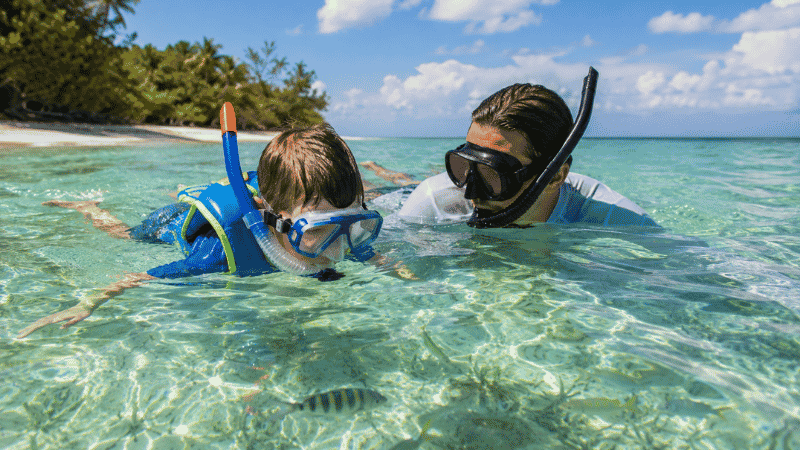
Children as young as 5–6 can snorkel successfully in the right conditions. The key variables are comfort with water, mask fit, and patience.
Age and Readiness
5–7 years: Can snorkel with a properly fitted child mask and snorkeling vest for buoyancy. Requires close adult supervision and calm, shallow conditions. Attention span is short — plan for 20–30 minutes maximum.
8–12 years: Generally ready for a full snorkeling experience in appropriate conditions. Can learn to clear the mask and snorkel independently.
Teens: Treat as adults for gear and technique. Teens often take to snorkeling faster than adults because they have less anxiety about being in the water.
Gear for Kids
Child-sized masks are essential — an adult mask on a child’s face won’t seal and will flood constantly. Size the mask for the child’s face using the same fit test (hold without strap, inhale through nose).
A snorkeling vest provides buoyancy and significantly reduces anxiety for young swimmers. It’s not a substitute for swimming ability, but it allows less confident swimmers to focus on the experience rather than staying afloat.
Child fins should fit snugly. Many children prefer to snorkel without fins initially — less gear to manage while they’re learning.
Location for Kids
The calmest, clearest, shallowest water you can find. Point of Rocks at Siesta Key is appropriate for older children (8+) who are comfortable in the water. For younger children, look for sheltered coves or calm, shallow Gulf areas where you can stand next to them throughout.
Snorkeling Safety — When to Stay Out of the Water
Snorkeling is genuinely safe in appropriate conditions. The conditions matter.
Visibility: If you can’t see 5–6 feet below the surface, conditions are too poor for productive or safe snorkeling. Low visibility happens after storms, in murky river-influenced water, or during periods of high wave action.
Current: Check for current before entering. Float a piece of debris and watch which direction it moves. If there’s a significant current, beginner snorkelers should not enter — currents are exhausting to swim against and can pull you away from your entry point.
Waves: Waves above 2–3 feet make snorkeling uncomfortable and increase the risk of being pushed onto rocks or into obstacles. Calm mornings are consistently better than afternoons on Florida beaches.
Weather: Lightning is an immediate exit signal. Florida’s afternoon thunderstorm season (June–August) means any snorkel plan should include a morning schedule. If you see storm clouds building, get out of the water.
Solo snorkeling: Don’t snorkel alone. The buddy system isn’t just a rule — it’s the difference between a problem being managed and a problem becoming an emergency. Snorkel with at least one other person who knows where you are.
When to Seek Medical Attention
Seek medical attention after a snorkeling session if you experience:
- Difficulty breathing that doesn’t resolve with rest
- Chest pain or tightness
- Severe ear pain (can indicate a pressure injury or ear infection from water entry)
- Skin rash or welts after potential jellyfish contact that spreads or doesn’t improve
- Any sign of allergic reaction — hives, swelling, difficulty swallowing
Jellyfish stings encountered while snorkeling should be treated the same as beach stings — rinse with seawater, remove tentacles with tweezers, apply heat or vinegar depending on species. Most Florida Gulf jellyfish stings are painful but not medically serious.
If You Only Have 10 Minutes Before Getting in the Water
Check these five things and you’re ready:
- Mask seal: Hold it to your face, inhale, confirm it holds. If not, swap it.
- Anti-fog: Spit on the inside, rub, rinse with seawater.
- Snorkel mouthpiece: Confirm it’s comfortable and you’ve sealed your lips around it.
- Fins: On your feet and snug.
- Buddy: Someone knows where you’re going and is either with you or watching.
That’s it. Everything else is learned in the water.
Frequently Asked Questions
Is snorkeling hard for beginners? No, but it has a 15–20 minute adjustment period before it feels natural. The most common beginner difficulties are mask fogging (solved by anti-fog treatment), water in the snorkel tube (cleared with a sharp exhale), and breathing anxiety (resolved by slowing down and exhaling more fully). Most people who find snorkeling difficult are in that first adjustment window — stick with it.
What’s the difference between snorkeling and scuba diving? Snorkeling stays at the surface, requires no training or certification, and uses only a mask, snorkel, and fins. Scuba diving allows you to descend to depth using tanks and a regulator, requires certification, and involves significantly more equipment. For a first underwater experience, snorkeling is the right starting point.
What age can kids start snorkeling? Children as young as 5–6 can snorkel in calm, shallow conditions with a child-sized mask and snorkeling vest for buoyancy. The mask must fit the child’s face — not an adult mask. Older children (8+) can handle a full snorkeling experience in typical conditions.
How do I breathe while snorkeling? Through your mouth only, slowly and fully. Inhale completely, exhale completely. The most common mistake is breathing too quickly and shallowly — if you feel short of air, slow down and focus on a longer exhale. The slight resistance of the tube is normal.
Where is the best snorkeling in Florida without a boat? Point of Rocks at Siesta Key (south end of Crescent Beach, Sarasota), the St. Andrews State Park jetty at Panama City Beach, and the Gulf waters around Caladesi Island near Clearwater Beach. All three are accessible from shore with no boat required.
Do I need a wetsuit for Florida snorkeling? Not in summer — Gulf Coast water temperatures run 80–85°F in summer and stay above 70°F through October. A UPF rash guard provides sun protection on extended sessions. Winter snorkeling (November–February) in cooler water (65–70°F) is more comfortable with a 3mm shorty wetsuit.
What should I do if my mask fogs while snorkeling? Surface briefly, lift the mask off your face, dip it in the water to rinse, then re-apply anti-fog (spit and rub) and re-seal. The long-term fix is proper anti-fog treatment before the session starts — new masks especially need pre-treatment with toothpaste to remove the manufacturing coating that causes instant fogging.
The Bottom Line
Snorkeling for beginners comes down to three things: gear that fits, technique that’s relaxed, and water conditions that are forgiving.
Get a mask that actually seals to your face. Anti-fog it properly. Learn to breathe slowly and completely through the tube rather than fighting it. Start in calm, shallow water where you can stand up at any moment. Give yourself 20 minutes to adjust before deciding how you feel about it.
The first time you find yourself floating above a patch of sea grass watching a school of fish moving underneath you, completely calm, breathing easily through the tube — that’s when the adjustment period ends and the actual experience begins.
It’s worth the 20 minutes.
Ready to go snorkeling in Florida? Read our destination guides:
- Things to Do in Siesta Key — Point of Rocks Snorkeling
- Things to Do in Panama City Beach — Shell Island & St. Andrews Jetty
- Things to Do in Clearwater Beach — Caladesi Island
- What to Bring to the Beach: Complete Florida Beach Gear Guide
References
- American Journal of Emergency Medicine — Full-Face Snorkel Mask Safety Incidents: sciencedirect.com
- Centers for Disease Control and Prevention (CDC) — Open Water Swimming Safety: cdc.gov
- Divers Alert Network (DAN) — Snorkeling Safety Guidelines: dan.org
- Florida Fish and Wildlife Conservation Commission — Marine Life Interaction Guidelines: myfwc.com
- American Red Cross — Water Safety Guidelines: redcross.org