
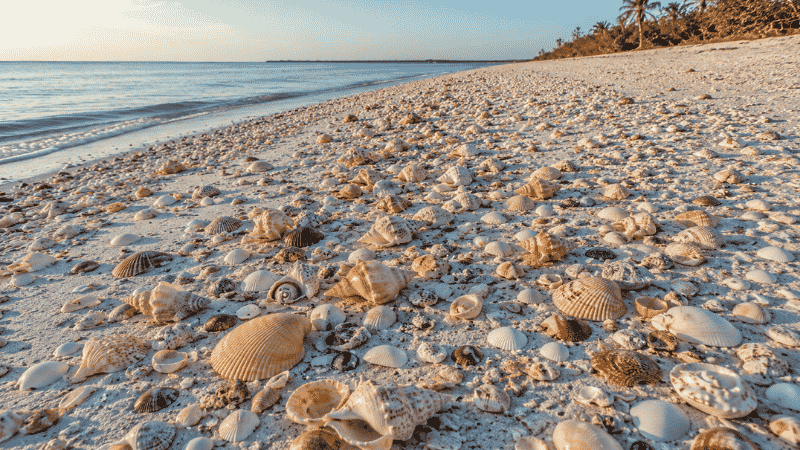
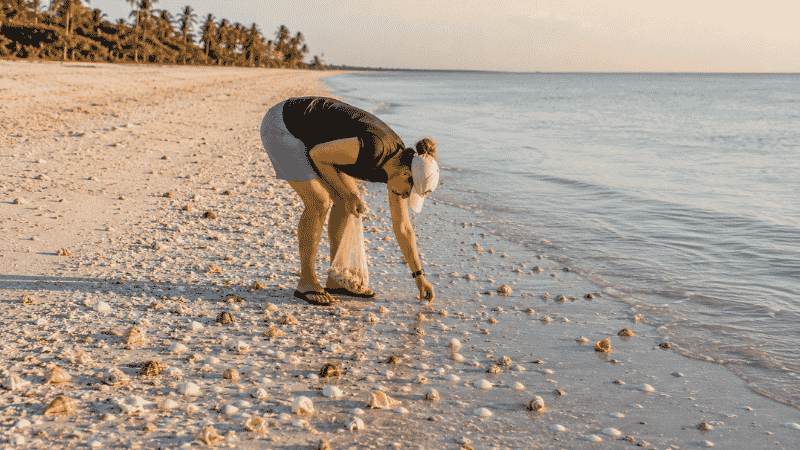
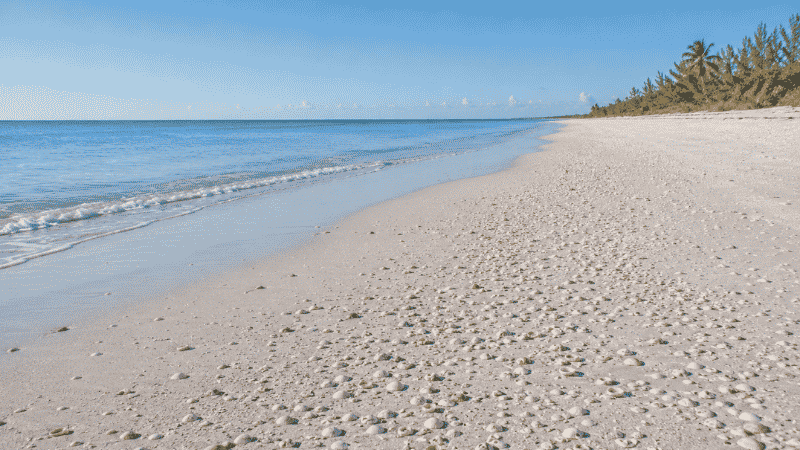
There’s a specific posture that gives Sanibel Island visitors away. Bent at the waist, eyes fixed on the sand, moving slowly along the water’s edge with a mesh bag in one hand — they call it the “Sanibel Stoop,” and once you’ve done it for 20 minutes on these beaches, you understand exactly why it became a thing.
Sanibel Island is ranked the #1 shelling beach in North America by Travel & Leisure, and it’s not a marketing claim. The geography makes it literal: the island curves east-to-west along the coastline rather than running north-to-south like most barrier islands. This orientation acts like a scoop, collecting shells drifting up from the Caribbean and Gulf currents that would wash past other islands entirely. The result is beaches so dense with shells that the sand itself is often more shell than sand.
But most first-time visitors to Sanibel Island shelling arrive without a clear sense of what they’re doing — what to look for, when to go, which beach to walk, and how to tell a live shell from an empty one. This guide covers all of it, along with everything else worth doing on Sanibel Island while you’re there.
Key Takeaways
- Sanibel Island’s east-west orientation makes it the #1 shelling beach in North America according to Travel & Leisure — the island’s shape literally scoops shells from Caribbean and Gulf currents
- The best shelling happens within 2 hours of low tide, especially after storms and during new and full moon spring tides when shell exposure is greatest
- It is illegal to collect live shells on Sanibel Island — Florida law prohibits taking live mollusks, and the fine is real. Leave any shell that has a living animal inside
- The Junonia — a spotted cone shell — is the holy grail of Sanibel shelling. Finding one is rare enough that local newspapers have historically run photos of lucky finders
- Bowman’s Beach and Blind Pass Beach consistently produce the best shell concentrations because they’re harder to reach — fewer visitors means more shells left on the sand
Why Sanibel Island Has the Best Shelling in North America
The reason comes down to geography, and it’s worth understanding because it explains everything about where to go and when to go.
Most Florida barrier islands run roughly north-to-south, which means Gulf currents and the shells they carry wash past the beaches and continue moving. Sanibel Island runs east-to-west — the southern end curves perpendicular to the prevailing shell-carrying currents from the Caribbean and the Gulf. This orientation acts like a natural net, intercepting shells that would bypass other islands entirely.
The underwater shelf in front of Sanibel’s beaches is also unusually broad and gradual, which slows incoming waves enough that shells aren’t smashed against the sand but instead deposited gently, often intact. This is why you find whole conchs and whelks on Sanibel when other beaches mostly produce fragments.
The result is beaches that are genuinely carpeted with shells in a way that’s unlike anywhere else on the US coast. When island residents dig gardens, they find whelks and conchs in the soil. Hotels offer rooms with dedicated shell-cleaning sinks. The annual Sanibel Shell Fair draws collectors from around the world every March.
Sanibel Island Shelling — When to Go for the Best Results
Timing is the single most important variable in Sanibel Island shelling, and most first-time visitors get it wrong by showing up randomly throughout the day.
The Low Tide Window
The best shelling happens within 2 hours before and after low tide. As the tide recedes, it exposes shells that were underwater — both shells that washed in and shells that were sitting just below the surface. The lower the tide, the more beach surface is exposed, and the more shells you’ll find.
Check the tide chart for Sanibel Island before you go — they’re available at sanibel-captiva.org and on any tide app. Plan to be on the beach at least 30 minutes before low tide hits and stay through the first hour after. This 3-hour window is when the most productive shelling happens.
Spring Tides — The Best of the Best
Twice a month, during the new moon and full moon, tidal range increases — the high tides are higher and the low tides are lower. These “spring tides” expose significantly more beach than regular tides and produce the best shelling of any time of month. If you can plan your Sanibel trip around a new or full moon, do it.
After Storms
A Gulf storm churns up shells from deeper water and deposits them on the beach in concentrations you won’t see on calm days. The day or two after a storm passes — once conditions are safe to be on the beach — is often the single best shelling window of any given month. Keep an eye on the weather in the days before your visit.
Early Morning
Beyond tidal timing, the practical reality is that shells don’t last long on Sanibel’s beaches. Other collectors are out there too. An early arrival — before 8 AM — means you’re walking beaches that haven’t been picked over yet. By mid-morning on a summer weekend, the best shells near the most accessible beach access points are gone.
Best Beaches for Sanibel Island Shelling
All of Sanibel’s Gulf-facing beaches produce shells — the question is how many people have walked them before you arrived.
Bowman’s Beach — The Best Overall
Bowman’s Beach consistently produces the best shell concentrations on the island, and the reason is simple: it requires effort to reach. There’s no direct road access — you park and walk a significant distance through a wooded area before reaching the beach. Most visitors choose easier options, which means Bowman’s beaches see fewer collectors per square foot.
The beach itself is wide, uncrowded, and genuinely beautiful. Facilities include restrooms and a small park area. It’s on the Gulf side on the western part of the island.
Practical note: The walk in is real. Wear shoes you can walk in, bring water, and bring everything you’ll need for the beach because there’s no concession stand.
Blind Pass Beach — Where Two Islands Meet
Blind Pass sits at the western end of Sanibel where the island meets Captiva Island across a tidal inlet. Shell concentrations here are exceptional — the pass creates turbulence that deposits shells in large quantities on both sides of the inlet. Both the Sanibel side and the Captiva side of Blind Pass are worth walking.
The larger shells tend to concentrate at the western end of the island chain, making Blind Pass and the beaches near Captiva Island particularly good for conch, whelks, and other larger species.
The Lighthouse Beach — Most Accessible, Still Productive
The Lighthouse Beach at the eastern tip of Sanibel is the most accessible beach on the island — it’s the first one you reach after crossing the Sanibel Causeway, and it has good parking and facilities. Because of the accessibility, it gets more visitors and the shelling is more competitive. But the tip of the island still concentrates shells from the tidal movement around the point.
The smaller, more delicate shells — coquinas, angel wings, olive shells — tend to concentrate here more than the larger species. Good for variety if not for volume.
Turner Beach — The Captiva Side of Blind Pass
Technically on Captiva Island, Turner Beach sits on the Captiva side of Blind Pass. Because it requires driving through Sanibel and across to Captiva, fewer day visitors make it this far. Shell density here is excellent, and the larger species — horse conchs, lightning whelks — are particularly well represented.
What You’re Looking For — Sanibel Island Shell Species
Walking Sanibel’s beaches without knowing what you’re looking for is like visiting a wine region without knowing the grape varieties. Here’s what actually matters.
The Junonia — The Holy Grail
The Junonia (Scaphella junonia) is a spotted cone-shaped shell, creamy white with brown spots arranged in spiral rows. It’s uncommon enough that local newspapers have historically run photos when someone finds one. If you find a Junonia on Sanibel, you’ve had an exceptional day.
It tends to wash up after significant Gulf storms, and most finds happen in the early morning following a weather event. It’s a deepwater species — the shells you find were brought in from offshore by storm action.
Lightning Whelk — Florida’s State Shell
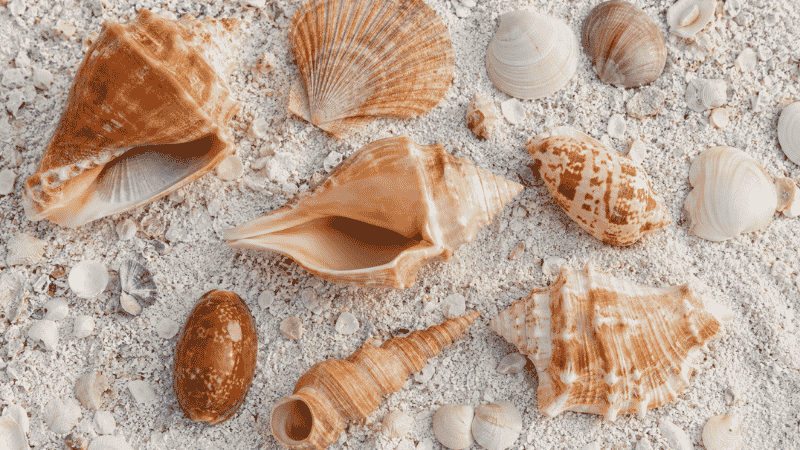
The lightning whelk is Sanibel’s most distinctive common find — a large spiral shell that opens on the left side (most shells open on the right, making the lightning whelk unique). They come in sizes from a few inches to nearly a foot long. The spiral pattern is creamy to tan with brown streaks radiating from the apex. Named for its resemblance to a lightning bolt.
Horse Conch — The Giant
The horse conch is the largest shell you’ll find on Sanibel — the adults can reach 2 feet in length, though beach specimens are typically smaller. Bright orange at the aperture, brown or grey on the exterior. Florida’s state shell is technically the horse conch, though the lightning whelk is more commonly associated with Florida beaches.
Junonia’s Smaller Cousins
Common finds include:
- Scallops: Fan-shaped bivalves, often complete and intact on Sanibel because of the gentle wave action
- Coquinas: Tiny wedge-shaped bivalves, often found in masses at the water’s edge, pastel colors ranging from white to purple
- Tulip shells: Elongated gastropods, tan with brown markings
- Murex: Spiky shells that look like they came from a coral reef — they did, in a sense
- Olive shells: Smooth, cylindrical, often shiny — one of the more elegant finds
Sand Dollars — The Rules
Sand dollars on Sanibel are coveted finds, but there’s a critical distinction: live sand dollars are fuzzy and purple-grey. Dead, bleached sand dollars are white. Leave the live ones in the water. Taking live sand dollars is illegal, and beyond the legal issue, it’s ecologically harmful. A live sand dollar returned to the water survives. A live sand dollar taken home dies.
The Law — What You Can and Cannot Take
Florida law is specific about shell collection, and Sanibel enforces it.
You can take: Empty shells — shells with no living animal inside. Up to 2 gallons per person per day.
You cannot take: Live shells — any shell with a living mollusk inside. Live sand dollars, live starfish, live sea horses. Protected species shells.
How to tell: If a shell has an operculum (a hard circular or oval door covering the opening), it may still have a living animal inside — don’t take it. If you see movement, soft tissue, or smell anything organic from the shell, put it back. Sand dollars: white and bleached = okay, fuzzy and purple-grey = living, put it back.
The fine for taking live shells is real and actively enforced on Sanibel. The island takes its ecological standards seriously.
The Sanibel Stoop — Technique That Works
The “Sanibel Stoop” — bent at the waist, eyes scanning the sand — is what shelling looks like in practice, and it works. Here’s the technique that improves your results:
Walk slowly into the wind. Wind-driven waves deposit shells on the downwind end of each beach stretch. Walking into the wind means you’re walking toward where shells are accumulating.
Focus on the wave wash zone. The strip of wet sand at the edge of the receding tide is where shells are freshest and most exposed. Shells further up the beach have often been picked over.
Shuffle your feet in the wet sand. Partially buried shells reveal themselves when you shuffle. This also alerts any stingrays resting in the shallow water — the same Sanibel Stoop technique doubles as stingray safety.
Bring the right gear: A mesh bag lets water drain and sand fall through. A small scoop is useful for retrieving shells in the wave wash without getting your hands full of wet sand every time. Water shoes protect your feet on shell-heavy beach sections.
The 2-gallon limit: You are legally allowed to take up to 2 gallons of empty shells per person per day. This sounds like a lot until you realize how quickly you can collect on a productive Sanibel morning — have a rough sense of your container volume.
Things to Do in Sanibel Island Beyond Shelling
J.N. “Ding” Darling National Wildlife Refuge
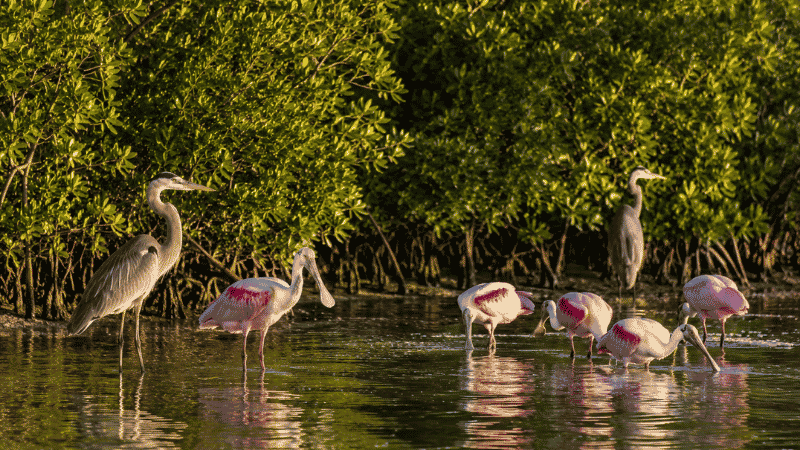
Ding Darling is one of the largest undeveloped mangrove ecosystems in the United States, covering nearly 7,000 acres of the interior of Sanibel Island. The Wildlife Drive — a 4-mile one-way road through the refuge — is open to cars, bikes, and walking, and produces wildlife sightings that are genuinely exceptional: roseate spoonbills, great blue herons, ospreys, alligators, manatees in the tidal channels, and hundreds of shorebird species during migration season.
Practical details: The Wildlife Drive is open daily except Friday. Entry fee applies. Tram tours are available if you want a guided experience. The best wildlife viewing is early morning — arrive within the first hour of opening for the most active wildlife before the heat builds.
Ding Darling is the reason many visitors who came to Sanibel for the shelling end up coming back for something entirely different. It’s one of the most productive birding locations in Florida.
Captiva Island — The Next Island Over
Captiva Island sits at the western end of Sanibel, connected by a single road. Where Sanibel has the infrastructure of a established resort community, Captiva feels more remote and quiet — it’s narrower, less developed, and has a distinct character. The beaches on the Gulf side of Captiva are excellent for shelling, particularly near Blind Pass and at the north end of the island.
The drive from Sanibel through to Captiva takes about 20 minutes. It’s worth doing if you’re spending more than one day on the island chain.
Kayaking the Back Bay
Sanibel’s bay side — the Pine Island Sound — is a protected water area with exceptional kayaking. The mangrove channels wind through the interior of the island and connect to the broader refuge waterway system. Wildlife viewing from a kayak is different from the Wildlife Drive — quieter, closer, and more likely to produce encounters with manatees and dolphins in the channels.
Several outfitters on the island offer kayak and paddleboard rentals. Morning departures are best for wildlife and for flat water conditions.
Best Time to Visit Sanibel Island
November through April is peak season — ideal temperatures (70s–low 80s°F), low humidity, minimal rain. Water is cooler (65–72°F in winter) but the shelling and wildlife conditions are excellent. This is when most visitors come, so accommodation prices are at their highest and the island is at its busiest.
May and October are the sweet spots for value and conditions. Weather is warm, water is comfortable for swimming (76–80°F), crowds thin from peak levels, and prices drop meaningfully.
Summer (June–August): Hot and humid, with daily afternoon thunderstorms. The shelling is still productive, and the water is warm. Accommodation prices drop further. Hurricane season begins June 1 — Sanibel learned the full weight of that risk with Hurricane Ian in 2022.
Hurricane Ian note: Hurricane Ian made direct landfall on Sanibel Island in September 2022 as a Category 4 storm. The Sanibel Causeway was significantly damaged and many structures on the island were destroyed. Recovery has been substantial — the island is open and operating — but some areas and businesses are still rebuilding as of 2026. Check current conditions before visiting.
Sanibel Island vs. Captiva Island — Which Should You Choose?
Choose Sanibel if: You want a full-service destination with restaurants, shops, the Ding Darling refuge, and easy access to the best shelling beaches. Sanibel has more accommodation options, more dining variety, and the infrastructure of an established beach community.
Choose Captiva if: You want quiet, fewer visitors, and a more remote feeling. Captiva is narrower, less developed, and has a different character — more like a private island escape. It has fewer dining options but excellent Gulf beaches.
Most visitors: Stay on Sanibel and day-trip to Captiva. This gives you the best logistics with access to both.
Frequently Asked Questions
Why is Sanibel Island famous for shelling? Sanibel Island’s east-west orientation — unusual for Florida barrier islands — positions it perpendicular to Gulf currents carrying shells from the Caribbean. This acts like a natural net, concentrating shells on Sanibel’s beaches that would bypass north-south oriented islands. The broad, gradual underwater shelf deposits shells gently rather than smashing them, producing intact specimens in extraordinary variety and density.
What is the best time to go shelling on Sanibel Island? Within 2 hours of low tide, especially during new and full moon spring tides when tidal range is greatest. Early morning maximizes the chance of walking beaches before other collectors. After Gulf storms is the single most productive window — storm action brings shells up from deeper water.
What shells can you find on Sanibel Island? Lightning whelks, horse conchs, scallops, coquinas, tulip shells, murex, olive shells, and — rarely — the prized Junonia, a spotted cone shell that draws collectors from around the world. Sand dollars and starfish are also found but subject to live-shell rules.
Is it legal to take shells from Sanibel Island? You can take empty shells — up to 2 gallons per person per day. Taking live shells (shells with living animals inside) is illegal under Florida law. Taking live sand dollars, starfish, or sea horses is also illegal. Sanibel actively enforces these rules.
What is the Sanibel Stoop? The bent-at-the-waist posture shellers adopt when scanning the sand for shells — so common on Sanibel that it became the island’s unofficial nickname for the activity. It’s the correct technique: eyes close to the sand, moving slowly, watching the wave wash zone for new deposits.
Is Ding Darling National Wildlife Refuge worth visiting? Yes — it’s one of the most productive wildlife viewing locations in Florida. The 4-mile Wildlife Drive produces roseate spoonbills, herons, egrets, alligators, and manatees in a single pass. Open daily except Friday. Best visited early morning when wildlife is most active.
The Bottom Line
Sanibel Island shelling is one of those experiences that sounds like casual tourism and turns out to be genuinely absorbing. The first hour on Bowman’s Beach at low tide, watching shells appear in the wave wash as the tide pulls back, finding your first lightning whelk or a perfect intact scallop — it’s hard to describe without sounding like you’ve been converted to something.
Come at low tide. Walk Bowman’s Beach. Check the tide charts. Shuffle your feet. Leave the live ones.
The rest takes care of itself.
Planning your Florida Gulf Coast trip? Read next:
- Best Beaches in Florida: The Realist’s Guide to Choosing the Right Shore
- Anna Maria Island Beach Guide: Florida’s Gulf Coast Secret
- Things to Do at the Beach: 30 Ideas Beyond Lying on the Sand
- What to Bring to the Beach: Complete Florida Beach Gear Guide
References
- Travel & Leisure Magazine — Top 10 Best U.S. Shelling Beaches (Sanibel Island #1 Ranking)
- Sanibel-Captiva Islands Chamber of Commerce — Shelling Guide: sanibel-captiva.org
- Florida Fish and Wildlife Conservation Commission — Live Shell Collection Regulations: myfwc.com
- J.N. “Ding” Darling National Wildlife Refuge — Official Site: fws.gov/refuge/jn-ding-darling
- Florida Department of Environmental Protection — Beach and Marine Resources Guidelines